
 skypilot
 skydiver

 bluethunder
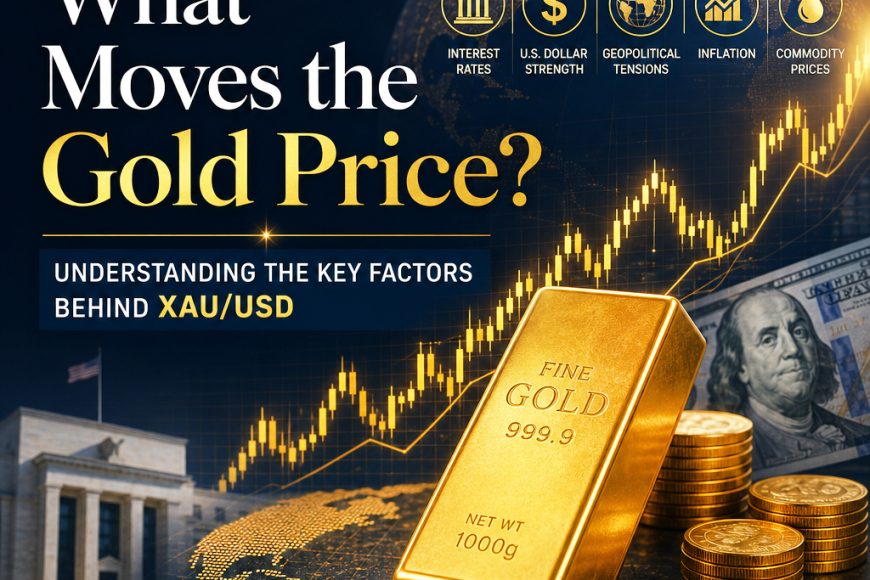
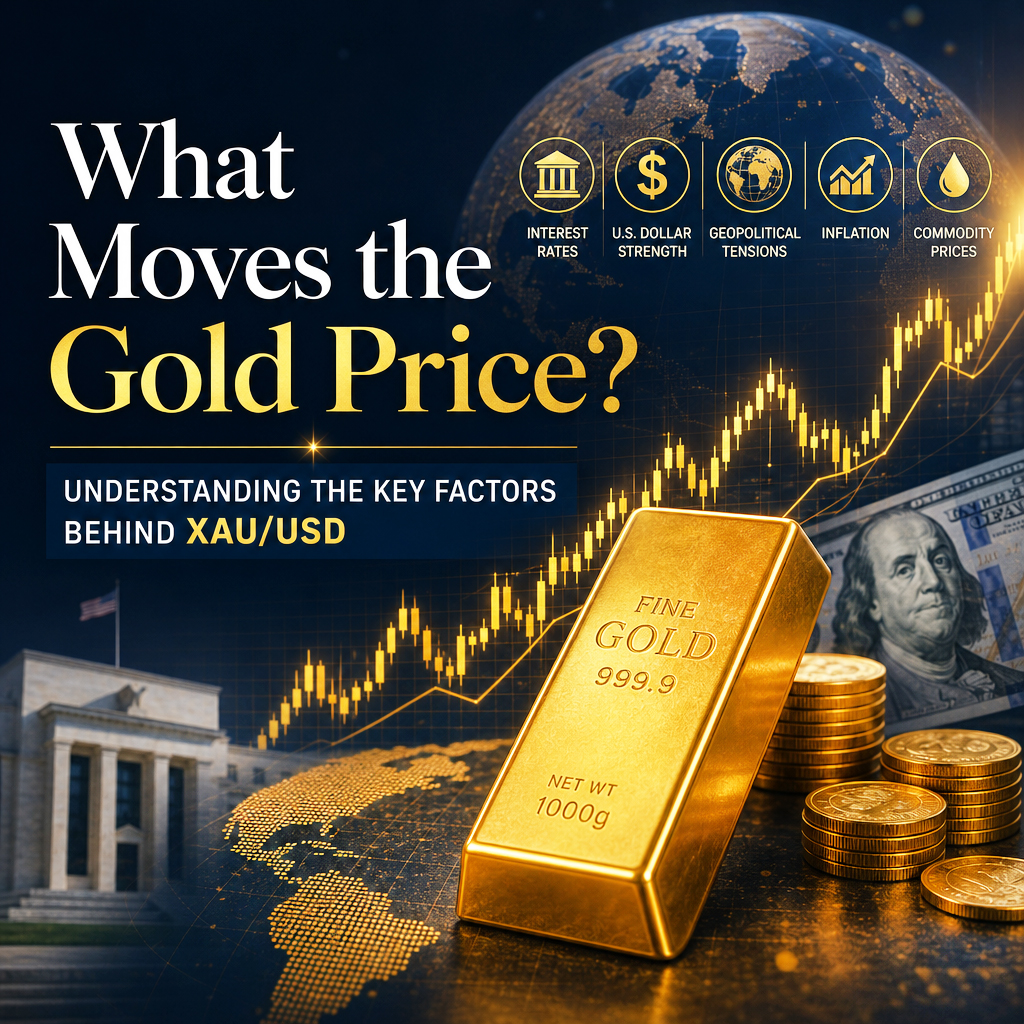
What Moves the Gold Price? Understanding the Key Factors Behind XAU/USD
Introduction: Understanding the Forces Behind Gold Price Movements
Gold is one of the most closely followed assets in the global financial markets. Its price is influenced by a combination of economic indicators, monetary policy decisions, currency movements, geopolitical developments and changes in investor sentiment.
For Forex traders, understanding these relationships is particularly important when trading XAU/USD, the gold-to-US-dollar market.
Unlike traditional currency pairs, gold is a commodity with a unique position in the international financial system. It is used by central banks as a reserve asset, held by investors as a potential store of value and traded by financial institutions and retail traders around the world.
Consequently, the gold price can react to several different forces simultaneously. A stronger US dollar may create downward pressure, while geopolitical uncertainty or increased central bank demand may provide support. Similarly, rising interest rates can make gold less attractive relative to interest-bearing investments, although the wider economic environment can influence how strongly this relationship develops.
In this article, we examine the most important factors affecting gold prices and explain how Forex traders can incorporate fundamental analysis into their XAU/USD trading decisions.
- The US Dollar: One of the Most Important Influences on Gold
The relationship between gold and the US dollar is one of the fundamental concepts in gold market analysis. International gold prices are generally quoted in US dollars. This means that changes in the dollar’s value can influence the cost of gold for buyers using other currencies.
When the US dollar weakens, gold may become relatively cheaper for international buyers. This can support demand and potentially contribute to higher gold prices. Conversely, a stronger US dollar can make gold more expensive for international purchasers, potentially reducing demand.
Why Does the Dollar Influence Gold?
The US dollar is the world’s primary reserve currency and plays a central role in international trade and financial markets. Gold and the dollar are therefore connected through several economic channels:
- International purchasing power.
- Global investment flows.
- Monetary policy expectations.
- Inflation expectations.
- Demand for alternative stores of value.
For example, if economic developments cause investors to anticipate lower US interest rates, the dollar may weaken. If this coincides with declining real yields, gold could benefit from increased investor interest.
However, traders should avoid assuming that gold and the dollar always move in opposite directions. During periods of financial stress, both assets can attract demand simultaneously.
How Forex Traders Can Monitor the Dollar
 The US Dollar Index (DXY) is a useful indicator for monitoring the dollar’s performance against a basket of major currencies. When analysing XAU/USD, traders may compare gold price movements with DXY to identify potential relationships and periods of divergence.
A declining DXY alongside rising gold prices may support a bullish interpretation. However, this relationship should always be considered alongside other economic developments.
- Interest Rates and Federal Reserve Decisions
Interest rates are among the most influential factors affecting the gold market. The US Federal Reserve determines monetary policy based on its assessment of inflation, employment conditions and broader economic developments. Its decisions can influence the dollar, bond yields, borrowing costs and investor expectations.
Why Do Higher Interest Rates Sometimes Pressure Gold?
Gold does not generate interest payments or dividends. Consequently, when interest-bearing investments become more attractive, the opportunity cost of holding gold may increase.
For example, if US Treasury yields rise significantly, investors may find government bonds more appealing relative to a non-yielding asset such as gold. This can create downward pressure on gold prices.
When interest rates decline, the opposite relationship may develop. Lower yields can reduce the opportunity cost of holding gold, potentially supporting demand.
Understanding Real Interest Rates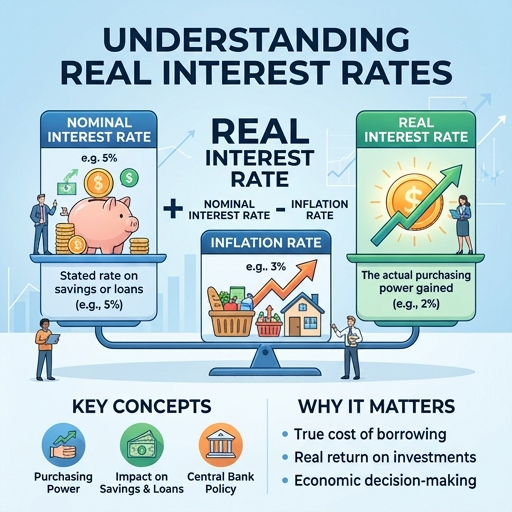
One of the most important concepts in gold analysis is the difference between nominal interest rates and real interest rates. Real interest rates represent nominal interest rates adjusted for inflation expectations. A simplified approximation is:
Real interest rate = Nominal interest rate − Expected inflation
For example, if a nominal yield is 4% and expected inflation is 2.5%, the approximate real yield is 1.5%. When real yields decline, gold can become more attractive relative to interest-bearing investments. This is why experienced gold traders often monitor inflation-adjusted Treasury yields rather than focusing exclusively on the Federal Reserve’s policy rate.
Federal Reserve Meetings and Gold Volatility
Federal Open Market Committee meetings can generate significant movement in XAU/USD. Markets react not only to actual interest rate decisions but also to the language used by policymakers. Statements suggesting a more restrictive monetary policy may support the dollar and pressure gold.
Conversely, indications that monetary policy could become more accommodative may weaken the dollar and support gold. Traders should pay attention to the Federal Reserve’s economic projections, inflation assessments and commentary about future monetary policy.
- Inflation and Its Relationship with Gold
Gold is frequently described as an inflation hedge because of its historical role as a store of value. When inflation rises, the purchasing power of money decreases. Some investors therefore consider gold as a potential way to preserve wealth over longer periods.
However, the relationship between inflation and gold is more complicated than simply assuming that higher inflation automatically produces higher gold prices.
Inflation Expectations Matter
Financial markets are forward-looking. Investors respond not only to current inflation but also to expectations about future inflation and the monetary policy response.
If inflation rises while central banks maintain relatively accommodative monetary conditions, real yields may decline. This can support gold. However, if higher inflation leads markets to anticipate aggressive interest rate increases, real yields and the US dollar may strengthen, potentially placing pressure on gold.
Important Inflation Indicators
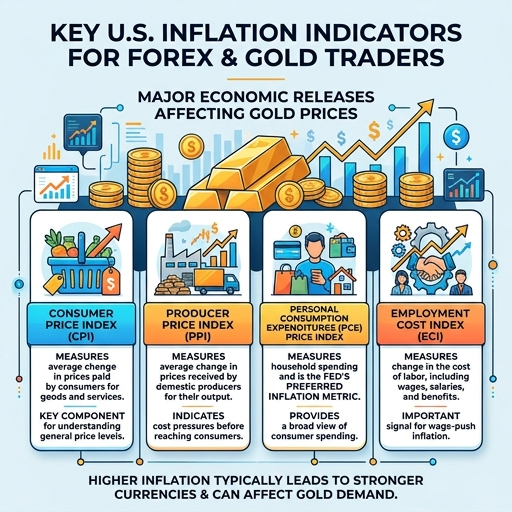 When analysing gold, Forex traders should monitor several major US economic releases:
- Consumer Price Index (CPI).
- Core Consumer Price Index.
- Personal Consumption Expenditures (PCE) Price Index.
- Core PCE inflation.
- Producer Price Index (PPI).
- Inflation expectations.
The PCE Price Index receives particular attention because it is the Federal Reserve’s preferred inflation measure. Understanding these indicators can help traders interpret potential changes in monetary policy expectations.
- Geopolitical Events and Safe-Haven Demand
Gold has historically played an important role during periods of geopolitical instability. International conflicts, political tensions, trade disputes and financial uncertainty can influence investor confidence.
When uncertainty increases, some investors seek assets they believe may provide greater protection against market instability. Gold is often included in this category.
Why Geopolitical Uncertainty Can Support Gold
Geopolitical developments can affect:
- Investor confidence.
- Global trade.
- Energy prices.
- Currency stability.
- Inflation expectations.
- Financial market liquidity.
For example, escalating international tensions may increase demand for defensive assets as investors reassess their exposure to riskier investments.
However, the market reaction is not always straightforward. In some circumstances, investors may sell gold to raise cash or cover losses elsewhere. Consequently, geopolitical uncertainty does not guarantee an increase in gold prices. Traders should evaluate the actual market reaction rather than relying exclusively on headlines.
- Central Bank Gold Purchases and Long-Term Demand
Central banks are important participants in the international gold market. Many countries hold gold as part of their official reserves, using it as a diversification instrument and a reserve asset independent of any single government’s monetary liabilities. Central bank gold purchases can therefore influence long-term demand.
Why Do Central Banks Hold Gold?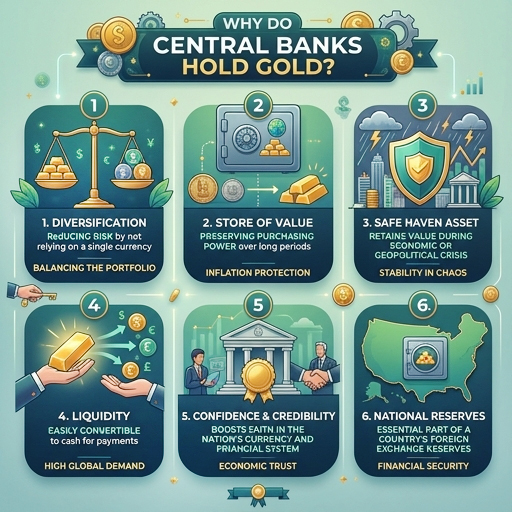
Central banks may hold gold for several reasons:
- Diversification of foreign exchange reserves.
- Long-term preservation of value.
- Reduced dependence on individual currencies.
- Confidence in gold as a globally recognised reserve asset.
- Portfolio stability during periods of financial uncertainty.
When central banks increase their gold reserves, this can provide structural support to demand. However, central bank activity should be analysed over longer periods rather than treated as an immediate trading signal. Changes in official gold reserves are generally more relevant to broader market trends than short-term intraday movements.
- Economic Data and Its Impact on XAU/USD
Economic announcements can create substantial volatility in the gold market. Since the United States is central to the international financial system, US economic releases often have a direct influence on the dollar and Treasury yields.
Important economic announcements include:
Non-Farm Payrolls (NFP): The monthly employment report can influence expectations about economic growth and Federal Reserve policy
- Unemployment Rate: Changes in labour market conditions can affect expectations about monetary policy.
- GDP Growth: Economic growth figures provide insight into the overall health of the US economy.
- Retail Sales: These figures help traders assess consumer spending and economic momentum.
- CPI and PCE: Inflation indicators can change expectations about future interest rate decisions.
- Federal Reserve announcements: Policy decisions and central bank commentary can affect gold through several financial channels.
A stronger-than-expected economic report may support the dollar if it increases expectations of tighter monetary policy. A weaker report may have the opposite effect.Nevertheless, the actual market reaction depends on expectations, positioning and the wider economic environment.
- Supply, Demand and Gold Market Fundamentals
Although financial market sentiment is extremely important for XAU/USD, physical gold supply and demand also influence the longer-term market.
Gold demand comes from several different sources:
- Jewellery manufacturing.
- Investment bars and coins.
- Exchange-traded funds.
- Central bank reserves.
- Technology and industrial applications.
On the supply side, gold production from mining companies and recycled gold are important contributors. Changes in mining output, production costs and recycling activity can influence the balance between supply and demand. For Forex traders, these factors are generally more relevant to longer-term fundamental analysis than short-term technical trading.
- How to Combine Fundamental Analysis with Technical Analysis
Understanding the factors influencing gold prices is only one part of trading XAU/USD. Fundamental analysis helps explain why the market may move, while technical analysis helps traders assess price structure and potential trading opportunities.
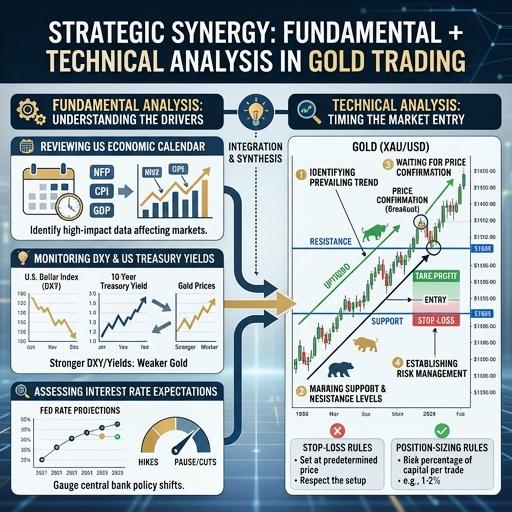 A combined approach can include:
- Reviewing the US economic calendar.
- Monitoring DXY and US Treasury yields.
- Assessing interest rate expectations.
- Identifying the prevailing gold market trend.
- Marking important support and resistance levels.
- Waiting for price confirmation before entering a position.
- Establishing stop-loss and position-sizing rules.
For example, if real yields are declining and the US dollar is weakening, the fundamental environment may be supportive of gold. A trader could then examine the price chart for a confirmed bullish structure rather than opening a position based on economic expectations alone.
Conclusion: Understanding the Bigger Picture Behind Gold Prices
Gold prices are influenced by a complex interaction of monetary policy, currency movements, inflation expectations, geopolitical developments and global investment demand. For Forex traders, understanding these relationships can provide valuable context when analysing XAU/USD.
Rather than concentrating on a single indicator or economic announcement, we should examine how several factors interact and how the market responds to new information. By combining fundamental analysis with technical tools and disciplined risk management, traders can develop a more structured approach to gold trading.
The most important lesson is that understanding why gold moves can be just as valuable as understanding where its price is moving.
Risk notice: Trading Forex and CFDs involves significant risk and may result in the loss of your invested capital. Leverage can magnify both profits and losses. Please read the applicable risk disclosures before trading.