

There is a huge difference compared to the stock market, for instance. Stock exchanges close their offices every evening, whereas the forex market is open 24/5.
Understanding Forex trading, including the market, gold trading, opportunities, and risks, is a highly complex undertaking, at least if you intend to trade on your own. Success in this field requires years of experience.
Here is a brief overview of what Forex is and what trading in that market entails. You can obtain further information by registering your interest and “coming on board.” This is simply a short introduction for beginners, investors, and anyone interested in the world of currency and gold trading.
What is the Forex market?
Forex trading, short for Foreign eXchange trading, is the buying and selling of currencies with the aim of benefiting from changes in their exchange rates. It is a major part of the global financial system, used by banks, businesses, governments, financial institutions, investors, and individual traders.
Every day, currencies are exchanged to support international trade, travel, investment, and financial transactions. Forex traders also participate in the market to speculate on whether one currency will strengthen or weaken against another.
For example, a trader might buy EUR/USD if they expect the euro to strengthen against the US dollar. If the exchange rate moves in the trader’s favor, the trade can generate a profit; if it moves in the opposite direction, the trader may incur a loss. Note that you can also trade on a falling rate.
The forex market is massive, with a daily turnover of approximately USD 7.5 to 9.5 trillion, according to the latest data from the Bank for International Settlements (BIS). In addition to traditional currencies (FX) and gold, trading primarily involves commodities, stock indices, cryptocurrencies, and individual stocks via derivative instruments such as CFDs (Contracts for Difference).
So, what is gold trading in Forex?
Gold has played an important role in trade, wealth preservation, and financial markets for centuries. Today, it remains one of the most closely watched precious metals in the world and is widely followed by investors and traders.
Gold trading is closely connected to Forex but it is not a currency. Gold is a commodity and precious metal. When you trade XAU/USD through a broker, you are usually trading a derivative, such as a contract for difference (CFD), rather than exchanging physical gold for US dollars. (See our FAQ for what this is etc.).
Unlike trading a currency pair, gold trading involves exposure to the price of a physical commodity. Depending on the product, a trader might own actual gold or simply speculate on changes in its price.
Gold is particularly interesting because its price can respond to several global forces:
- Economic uncertainty: Investors may increase their interest in gold during periods of financial or geopolitical instability.
- Interest rates: Lower real interest rates can make gold more attractive because gold itself does not pay interest.
- The US dollar: Gold and the dollar often move in opposite directions, although this relationship is not guaranteed.
- Inflation expectations: Some investors use gold as a potential store of value, but gold does not always protect purchasing power.
- Central bank activity: Central bank purchases and sales can influence demand.
- Market sentiment: Changes in investor confidence can create rapid price movements.
These influences can create trading opportunities, but they also make gold prices difficult to predict with certainty.
No. Inflation can support demand for gold, but the market’s response to interest rates, the dollar, economic growth, and investor expectations may push prices in either direction.
Gold occupies a unique position between commodities, currencies, investments, and financial risk management. It is not issued by a government, does not depend on a company’s profits, and does not promise interest payments. Its market value is determined by supply, demand, investor expectations, and broader economic conditions.
For some investors, gold provides diversification and a way to express concerns about financial instability. For active traders, it offers a liquid market in which economic news and shifts in sentiment can create opportunities as well as risks.
Leverage allows you to control a position larger than the funds you put up as margin. This is one reason gold trading can be attractive to active traders: relatively small price movements can create meaningful results. Leverage does not make a trade better. It makes the financial consequences of the trade larger.
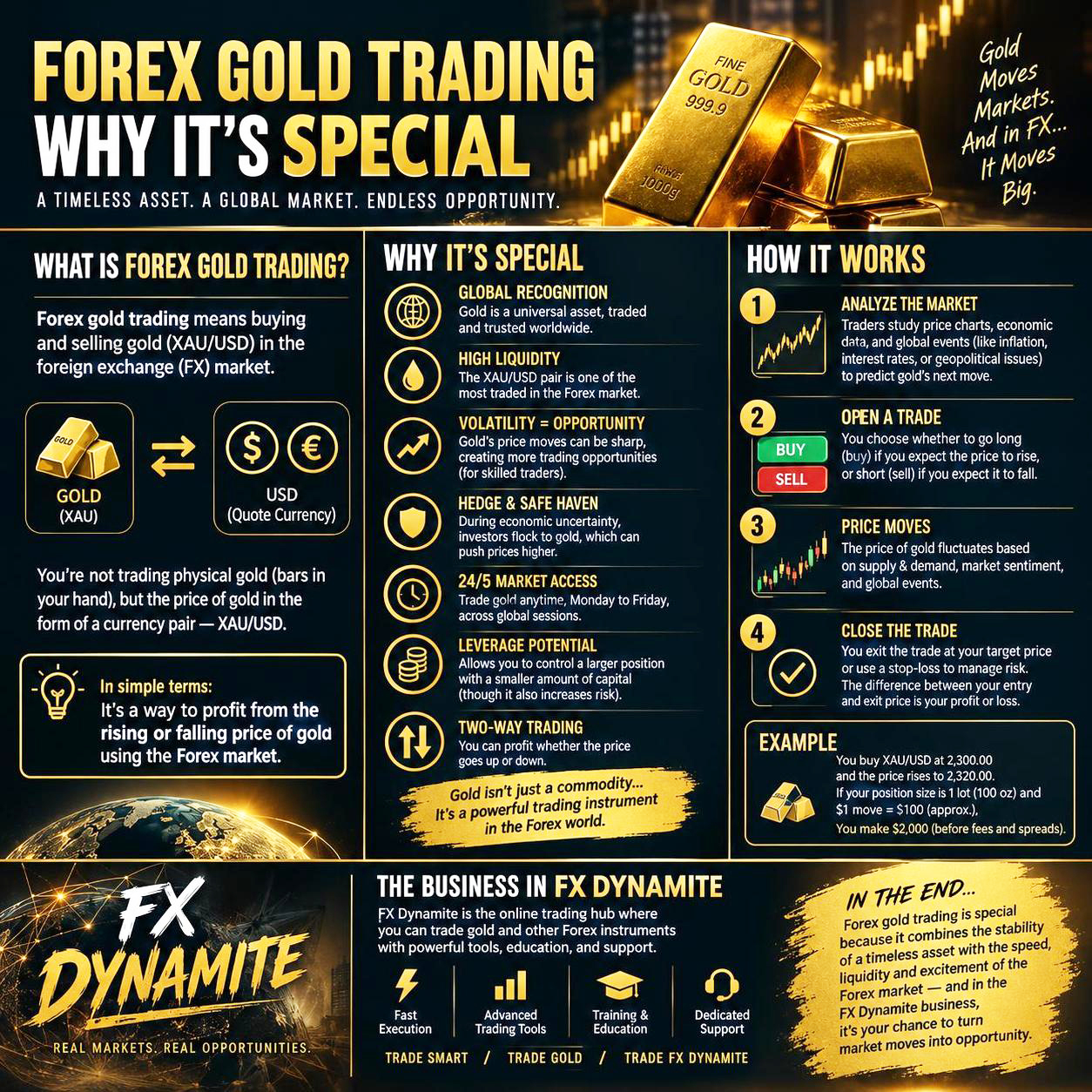
Why are so many traders interested in gold?
There are several reasons gold has become an important instrument for active traders and investors. Gold has a long history as a store of value and is traded internationally. It attracts jewellery buyers, industrial users, private investors, funds, and central banks.
With many CFD products, traders can open long positions when they expect prices to rise or short positions when they expect prices to fall. Both directions carry risk. Gold trading gives traders a way to express views on inflation, interest rates, currencies, financial uncertainty, and investor sentiment.
Traders can choose among physical gold, exchange-traded products, futures, options, and broker-offered derivatives. These products have different costs, risks, and ownership rights.
What affects the price of gold on the market?
- Interest Rates: Higher rates can reduce gold’s appeal, since it doesn’t yield interest.
- Inflation: Gold is often used as a hedge against inflation.
- Geopolitical Risk: Economic or political instability often drives investors toward safe-haven assets such as gold.
- US Dollar (USD): Gold is priced in USD, so the two often move inversely.
And what are the differences between Forex currency trading and gold trading?
The key distinction is that Forex measures the relative value of two currencies, while gold trading measures the value of gold through a physical market or a financial instrument linked to it.
Neither market is always more volatile, more profitable, or safer than the other. The answer depends on the instrument, the period being examined, market conditions, position size, and leverage.
| Feature | Forex currencies | Gold trading |
| What is traded? | One currency against another | Gold, or a financial instrument linked to its price |
| Common examples | EUR/USD, GBP/USD, USD/JPY | XAU/USD |
| Main price drivers | Interest rates, economic growth, inflation, central-bank policy, trade and capital flows | US dollar, interest rates, inflation expectations, geopolitical risk, investor demand, central-bank purchases and supply |
| Economic relationship | Relative strength of two economies and currencies | Value of a precious metal, often quoted in US dollars |
| Income from holding | Depends on the instrument; currency positions may incur or receive overnight financing or rollover | Physical gold pays no interest; leveraged derivatives may incur overnight financing |
| Common uses | International payments, hedging, investment and speculation | Portfolio diversification, hedging, investment and speculation |
| Trading behaviour | Varies widely by currency pair and market conditions | Can experience sharp moves around economic news, interest-rate changes and geopolitical events |
Today, paper currencies (fiat currencies) are valued through a floating exchange rate system within the global foreign exchange market. Unlike in the past, when money was pegged to gold or silver, modern paper money possesses no intrinsic value. Its value is determined entirely by supply and demand, as well as the global market’s confidence in a given country’s economy and central bank.
Gold has traditionally retained its value. When the cost of living rises, the value of gold often increases as well, making it a reliable hedge against inflation. In the current climate—where the purchasing power of paper money has declined significantly—gold remains stable. This makes it a dependable means of preserving value within an investor’s portfolio.
What makes gold trading special?
Gold has played an important role in trade, wealth preservation, and financial markets for centuries. Today, it remains one of the most closely watched precious metals in the world and is widely followed by investors and traders.
There is a huge difference compared to the stock market, for instance. Stock exchanges close their offices every evening, whereas the forex market is open 24/5.
Gold trading is closely connected to Forex trading because many online brokers offer gold priced in US dollars, commonly represented by the symbol XAU/USD. This symbol represents the market price of one troy ounce of gold in US dollars.
Unlike trading a currency pair, gold trading involves exposure to the price of a physical commodity. Depending on the product, a trader might own actual gold or simply speculate on changes in its price.
Gold is particularly interesting because its price can respond to several global forces:
- Economic uncertainty: Investors may increase their interest in gold during periods of financial or geopolitical instability.
- Interest rates: Lower real interest rates can make gold more attractive because gold itself does not pay interest.
- The US dollar: Gold and the dollar often move in opposite directions, although this relationship is not guaranteed.
- Inflation expectations: Some investors use gold as a potential store of value, but gold does not always protect purchasing power.
- Central bank activity: Central bank purchases and sales can influence demand.
- Market sentiment: Changes in investor confidence can create rapid price movements.
These influences can create trading opportunities, but they also make gold prices difficult to predict with certainty.
Gold trading on the Forex market is popular among traders who want to benefit from changes in the price of gold without necessarily
buying or storing physical gold. One of the most common instruments is XAU/USD, which tracks the price of gold against the US dollar.
Like any financial activity, gold trading offers potential opportunities, but it also involves significant risks. Understanding both sides is essential before getting started.
Advantages of gold trading…
- A globally recognized market
Gold is traded internationally and is followed by banks, investors, institutions, and individual traders. Its worldwide importance creates an active market with many participants. - Opportunities in rising and falling markets
Depending on the trading instrument, traders can take positions based on expectations that gold prices will rise or fall. However, correctly anticipating the direction of the market is never guaranteed. - Flexible trading opportunities
Gold is traded across major market sessions, allowing traders to choose times that suit their schedules. Trading hours and liquidity vary by broker and instrument. - No need to store physical gold when using CFDs
Gold contracts for difference (CFDs) allow traders to speculate on price movements without purchasing, transporting, or storing bullion. CFDs are derivatives, however, and do not give the trader ownership of physical gold. - Multiple factors to analyze
Gold prices respond to interest rates, the US dollar, inflation expectations, geopolitical events, central bank activity, and investor sentiment. These factors provide several ways to study the market and develop a trading strategy. - Accessible learning tools
Demo accounts, economic calendars, charting tools, and educational materials can help beginners understand gold trading before committing real money.
Disadvantages and risks of gold trading…
- Significant financial losses are possible
Gold prices can move sharply in either direction. A trade based on an incorrect prediction may lose money, and repeated losses can reduce trading capital quickly. - Leverage increases risk
Some Forex brokers offer leveraged gold CFDs, allowing traders to control a large position with a relatively small deposit. This magnifies both gains and losses and can lead to rapid depletion of the account. - Prices are difficult to predict
Interest-rate announcements, inflation reports, employment data, and geopolitical developments can cause sudden price movements. Even experienced traders cannot predict every market reaction. - Trading costs reduce profits
Spreads, commissions, overnight financing charges, and slippage can affect results. Frequent trading can make these costs particularly significant. - Emotional decisions can be costly
Fear, greed, impatience, and the desire to recover losses can lead to poor decisions. A disciplined strategy and clearly defined risk limits are important. - Not every broker or trading offer is trustworthy
Unregulated providers, fake investment schemes, misleading profit claims, and fraudulent account managers can put your money at risk. Always verify a broker’s regulatory status independently.

From the First Step to the Next Horizon
FX dynamite
Inspired by our work?
Signup! Together, we will build your ideal space


Premium Supplies
High-quality products and resources. Carefully selected premium solutions. Quality you can trust. Everything you need to succeed!
Up-to-Date Trends
Stay ahead of the latest trends. Discover new tools and opportunities. Fresh ideas for a changing market. Always evolving with the digital world.
© 2026 Exclusive interior. All Rights Reserved.