

Digital assets have outgrown their niche status and are becoming an increasingly important part of the global financial system. From Bitcoin and blockchain technology to digital asset trading and mining, these innovations are transforming how value is created, transferred, stored, and managed around the world.
By the way, did you know that Bitcoin was created in 2008 by Satoshi Nakamoto to function as a peer-to-peer electronic cash system that allowed online payments to be sent directly from one person to another without going through a bank or financial institution.
Not everyone knows about Bitcoin mining, what it is, or even that it is possible to do. But it is, absolutely! Bitcoin mining can be a real business, but it is very different from the picture many people have of “put a computer in the garage and earn Bitcoin.” Today, it is a highly competitive, electricity-intensive business where hardware efficiency and electricity cost are usually more important than simply owning a powerful computer.
In the United States, Canada, Brazil, Argentina, Europe, Australia, Japan, South Korea, India, Pakistan, and some South African countries, and some others, it is legal to use Bitcoin, with minimal or no restrictions.
In Hong Kong, it’s legal, but in China it is illegal. No country has Bitcoin as its official currency in 2026. However, some countries, e.g., El Salvador, adopted Bitcoin in September 2021 alongside the U.S. dollar. And The Central African Republic (CAR) adopted Bitcoin as legal tender in April 2022 alongside the CFA franc.
The conclusion is evident: Apart from Proof of Work, there is, among other things, the public blockchain, where Bitcoin transactions and confirmed blocks can be inspected using independent blockchain explorers. Anyone can examine transaction identifiers, block heights, timestamps, and other public blockchain data.
Bitcoin and blockchain technology demonstrate how decentralized systems can operate without relying entirely on traditional intermediaries. Bitcoin mining helps secure the network, validate transactions, and maintain the integrity of its decentralized ledger through the Proof-of-Work consensus mechanism. At the same time, Forex markets connect economies worldwide, while digital marketing and online business platforms enable entrepreneurs to reach new audiences and develop innovative business models.
At the same time, the convergence of digital assets, Forex trading, and Internet Marketing is opening new opportunities for technological innovation, financial education, and digital entrepreneurship. Understanding these developments, including their potential benefits, risks, and regulatory requirements, is essential for navigating the financial landscape of tomorrow.
Knowledge creates opportunities. Innovation drives progress. Transparency builds trust. The future of finance is evolving, and knowledge, responsible innovation, and transparency will be key to participating in that transformation.
Because the future belongs not only to those who embrace innovation, but to those who understand it, question it, use it responsibly, and help make its benefits accessible to others.
Bitcoin Mining Explained: How it works, what you need, is it worth or not?
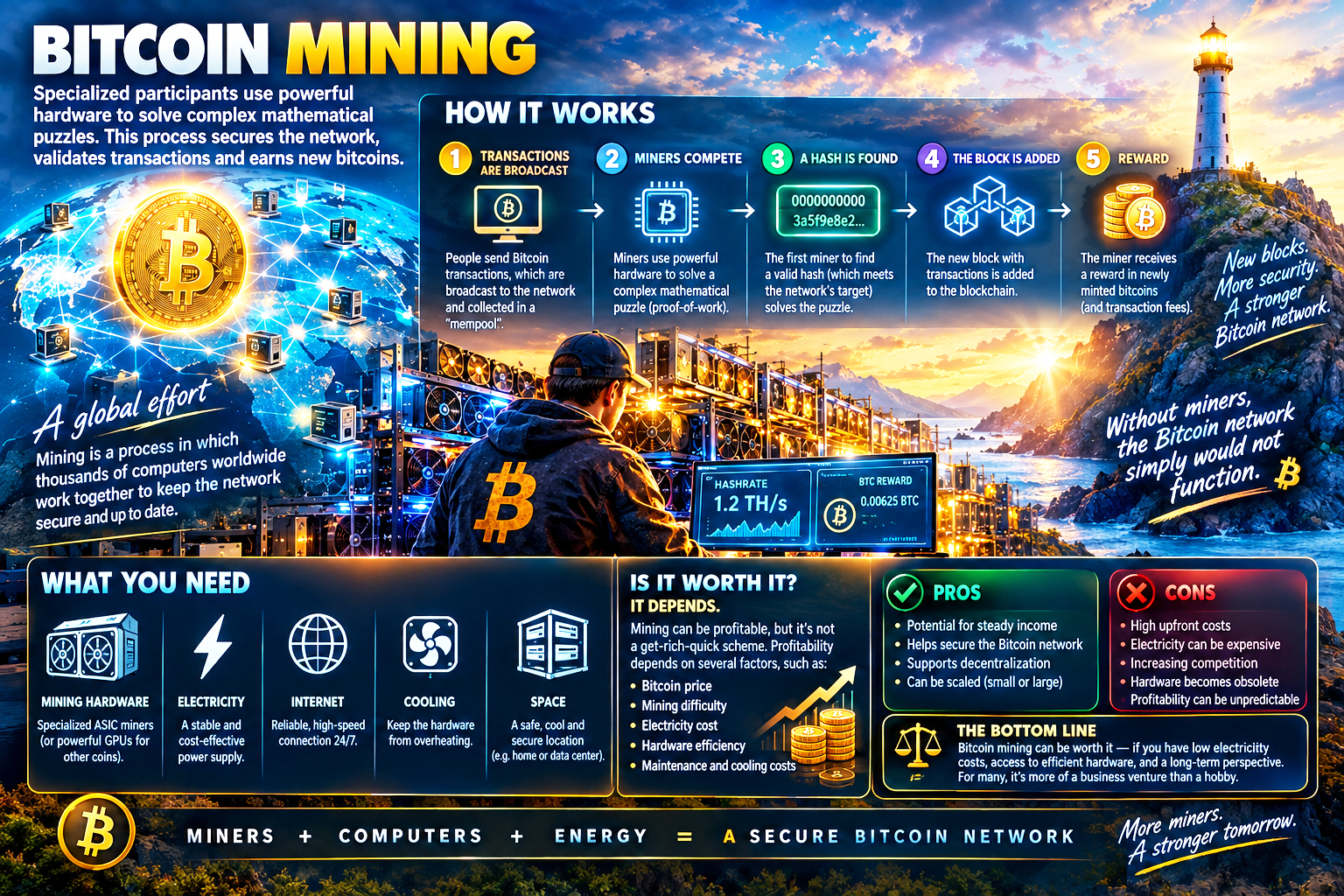
Bitcoin mining is the process that keeps the Bitcoin network secure and decentralised. Specialized participants use powerful hardware to solve complex mathematical puzzles. The result of this process is that new bitcoins are put into circulation and recently executed transactions are added to the blockchain.
Miners group transactions into blocks and compete to solve a cryptographic challenge. The first one to succeed gets to add their block to the chain and earns a reward.
Bitcoin is a decentralized system, meaning it does not rely on any bank or government to handle transactions. Instead, it uses “mining”, a process in which thousands of computers worldwide work together to keep the network secure and up to date.
“Miners” are crucial, as they perform three key functions:
- Verifying transactions: When someone sends bitcoin, these actors check that the sender has sufficient funds and that the transaction complies with the rules
- Preventing fraud: Without mining, someone could attempt to spend the same bitcoin twice (known as “double-spending”). Mining makes this practically impossible by permanently recording every transaction in a shared ledger
- Creating new units: Mining is the only way to create new bitcoin. This ensures the supply remains limited and predictable.
Without these actors, the Bitcoin network simply would not function. They provide the trust, transparency, and security that allow bitcoin to exist without central oversight.
the Beginning…
But first, let us look back a moment before delving into the more technical aspects. The story of Bitcoin’s emergence and its creator is fascinating.
Consider the history and origins of Bitcoin, a revolutionary digital currency. It was launched in 2009 by Satoshi Nakamoto. Initially, mining Bitcoin was a relatively simple process that could be performed using standard personal computers.
He start writing bitcoin’s code in the 2nd quarter of 2007. And on 18 August 2008, he registered the domain name bitcoin.org. Nakamoto published the Bitcoin whitepaper on October 31, 2008, and launched the network in January 2009.
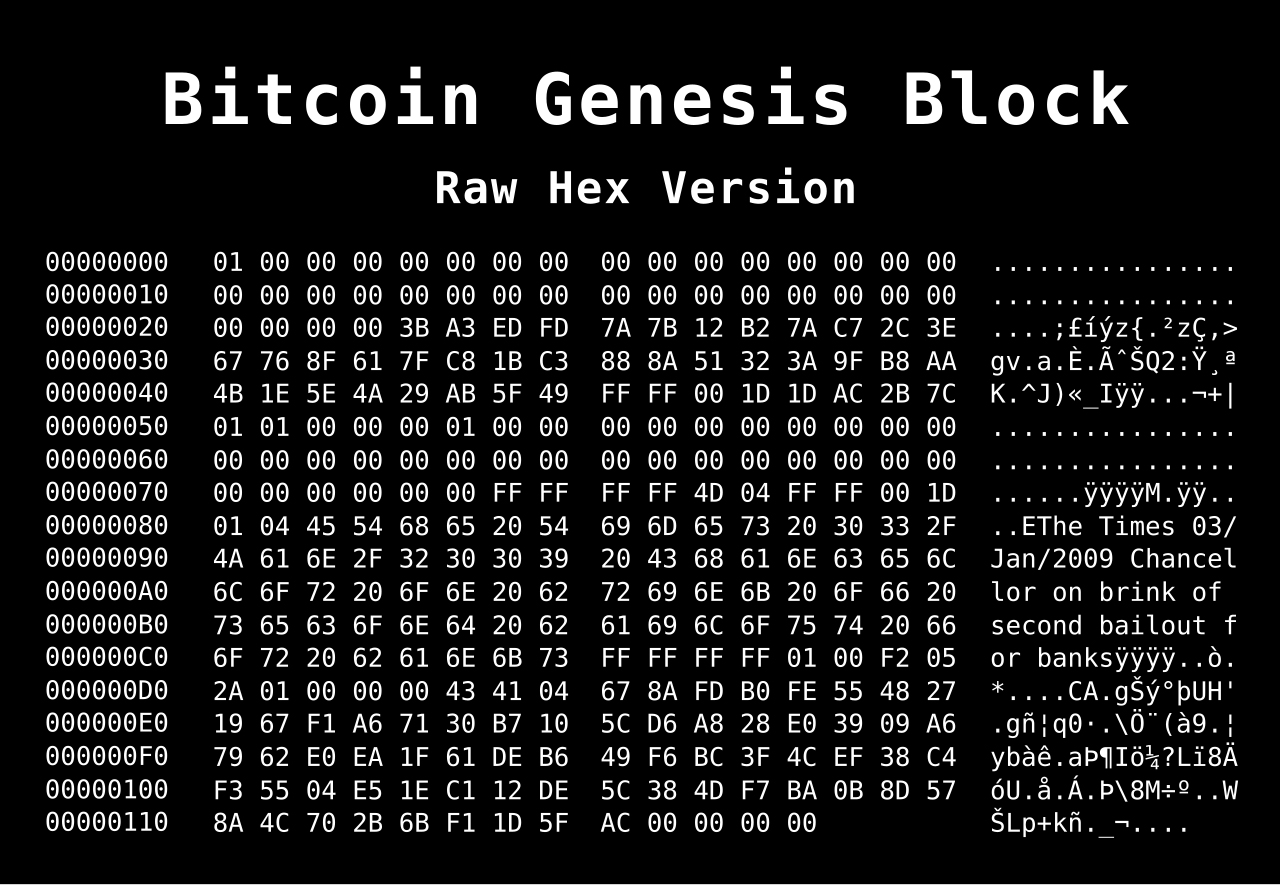
On 9 January 2009, Nakamoto released version 0.1 of the bitcoin software on SourceForge and launched the network by defining the genesis block of bitcoin (block number 0), which had a reward of 50 bitcoins.
The story of the enigmatic Satoshi Nakamoto, Bitcoin’s creator,is truly remarkable and deserves a chapter of its own; here, we touch upon it only briefly.
Satoshi Nakamoto is, however, a pseudonym; his real identity, background, education, and previous work remain entirely unknown. (note: it can also be a group). In his profile on the P2P Foundation, he stated that he lived in Japan and was born in 1975. However, most observers do not believe he is Japanese. The software code reveals a highly skilled programmer with a deep understanding of cryptography and computer networks.
Satoshi disappeared in April 2011. His final known email to other developers stated that he had “moved on to other things.” Since then, the creator has remained completely silent.
Why Satoshi Nakamoto disappeared? The best guess is because, to ensure Bitcoin remained fully decentralized and independent of a single leader.
Completely silency
Top candidates for who he might be include Hal Finney (early cryptographer), Nick Szabo (creator of Bit Gold), and Adam Back (developer of Hashcash).
In a high-profile March 2014 article in Newsweek, journalist Leah McGrath Goodman doxed Dorian Prentice Satoshi Nakamoto, a Japanese-American man living in California, whose birth name is Satoshi Nakamoto. Her methods and conclusion drew widespread criticism. In a brief in-person interview, Dorian seemed to confirm his identity as its founder, saying: “I am no longer involved in that and I cannot discuss it. It’s been turned over to other people. They are in charge of it now. I no longer have any connection.”
Later that day Dorian Nakamoto denied all connection to bitcoin, saying he had never heard of it before and that he had misinterpreted Goodman’s question as about his previous work for military contractors, much of which was classified. And later that same day as well, the pseudonymous Nakamoto’s P2P Foundation account posted its first message in five years: “I am not Dorian Nakamoto.”
When Satoshi Nakamoto launched Bitcoin in January 2009, it had no established monetary value whatsoever, as there were no trading platforms or exchanges, and it was not traded against any other currency. The first price was set in 2010. It was under $0.004; this was determined via an electricity bill and the first known Bitcoin pizza transaction , where 10,000 BTC were paid for two pizzas.
Analytics firms such as Arkham Intelligence estimate that Satoshi owns approximately 1.1 million Bitcoin. This makes the pseudonymous figure one of the world’s wealthiest people (worth nearly $80–90 billion, depending on the exchange rate). Not a single one of these coins has ever been moved or sold, and as mentioned, no one knows who he is or where he is located.
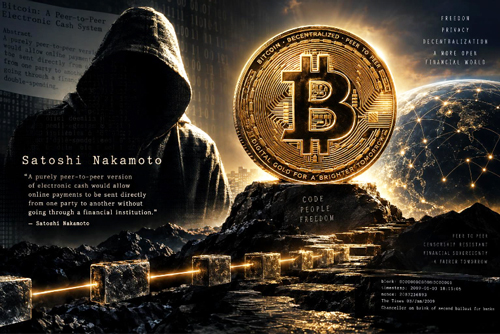


A bust dedicated to Satoshi Nakamoto, installed in Budapest, Hungary, in 2021, along with an illustration of his disappearance.
A statue of Satoshi Nakamoto by Valentina Picozzi was unveiled in Lugano, Switzerland, designed to appear differently from different angles. It was stolen and thrown into the lake but recovered.
“The Times 03/Jan/2009 Chancellor on brink of second bailout for banks.” Satoshi Nakamoto message embedded in the coinbase of the first block.
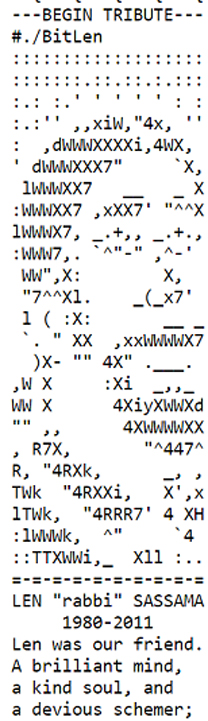
Len Sassaman memorial on the bitcoin blockchain. An ASCII art tribute by Dan Kaminsky in honor of Len, to be permanently embedded into Bitcoin’s blockchain,
Understanding hashes
So, what ia a hash? A hash resembles a fingerprint. It is is a unique, fixed-length digital fingerprint created by running block data through a mathematical function. An one-of-a-kind electronic code created from input data. In bitcoin mining, hashes are used to stand for all the data in a block in a compact, safe and secure way. Bitcoin uses a details formula called SHA-256 (Secure Hash Formula 256-bit), which always generates a 64-character string of letters and numbers.
How does mining Hashing Works?
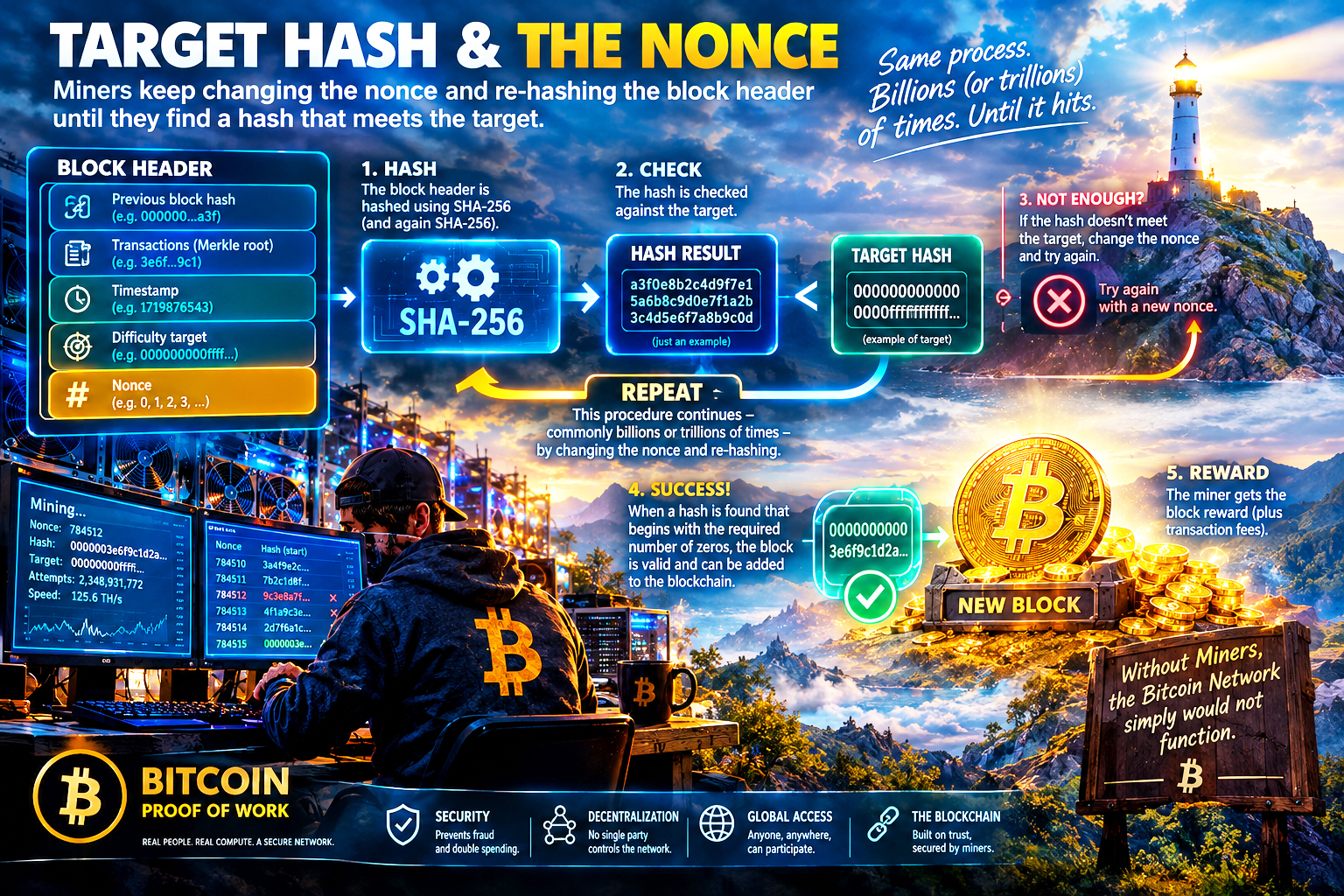
- Block Header: Miners combine transactions, timestamps, and previous codes
- The Nonce: Miners add a random changing number called a nonce
- SHA-256 Algorithm: The computer runs this entire package through the SHA-256 Cryptographic Hash Algorithm
- The Target: The resulting hash must fall below a specific network target (start with enough leading zeros)
- The Guessing Game: Because outputs are random, miners must guess billions of nonces per second until one works
Right here is why hashes issue:
- Safety and security: hashes make it nearly difficult to alter purchase information without it being observed. If you alter simply one item of information in a block, the whole hash adjustments
- Consistency: the same input always creates the very same hash However even a small modification in input, like one letter, will certainly lead to a totally different hash
- Efficiency: hashes aid the network verify data quickly without requiring to store or procedure all the initial info again
To effectively mine a block, miners need to create a hash that starts with a particular variety of zeros. The only method to do this is by changing a small part of the input– called the nonce– and trying again. This is what makes mining computationally intensive. Miners may need to attempt trillions of various nonces prior to they hit on a hash that works.
Maintain and re-hashing
You can think of it like playing a huge presuming game. The winning hash fulfills rigorous policies established by the network, and locating it confirms that the miner has actually done the needed work. This is what makes bitcoin safe and secure– it’s backed by the computer power of thousands of miners completing to find valid hashes.
Target hash and the nonce
The nonce is an arbitrary number miners get used to discover a legitimate hash. Each effort is a new hunch. Because the procedure is random, high-powered equipments attempt trillions of combinations per second until one fits the standards.
Picture you’re trying to find a hash for the phrase “good morning”. You run it via a SHA-256 generator and get a abolutely nonsens result for a human being to read, but the macnines ca read it. For them it is a legitimate hash, yet it does not begin with the required number of zeros to be accepted by the Bitcoin network. So, miners fine-tune a little part of the input called the nonce, perhaps including a “number” at the end, and attempt once again.
They maintain readjusting and re-hashing: This procedure continues– commonly billions or trillions of times– till a hash is discovered that begins with the needed variety of nos. The string begins with a lengthy sequence of absolutely nos, which is what the Bitcoin network seeks to verify the block. That’s just how miners “win” the chance to add a new block and make their reward.
This trial-and-error technique is what makes mining so computationally requiring. It’s why effective equipments and low-cost electrical energy are crucial to success. Mining does not produce exactly “1 BTC” per session, each block mined yields 3.125 BTC, and a new block is mined about every 10 mins. in a pool, miners earn fractions of incentives based upon calculating power. Solo mining may take years. In contrast, swimming pool miners receive smaller, consistent payouts.
Lorem ipsum dolor sit amet, consectetur adipiscing elit. Ut elit tellus, luctus nec ullamcorper mattis, pulvinar dapibus leo.


Solo and Pool mining
To complicate matters further
…There is one more thing you need to consider, especially if you want to mine yourself, and that is whether to mine solo or in a pool.
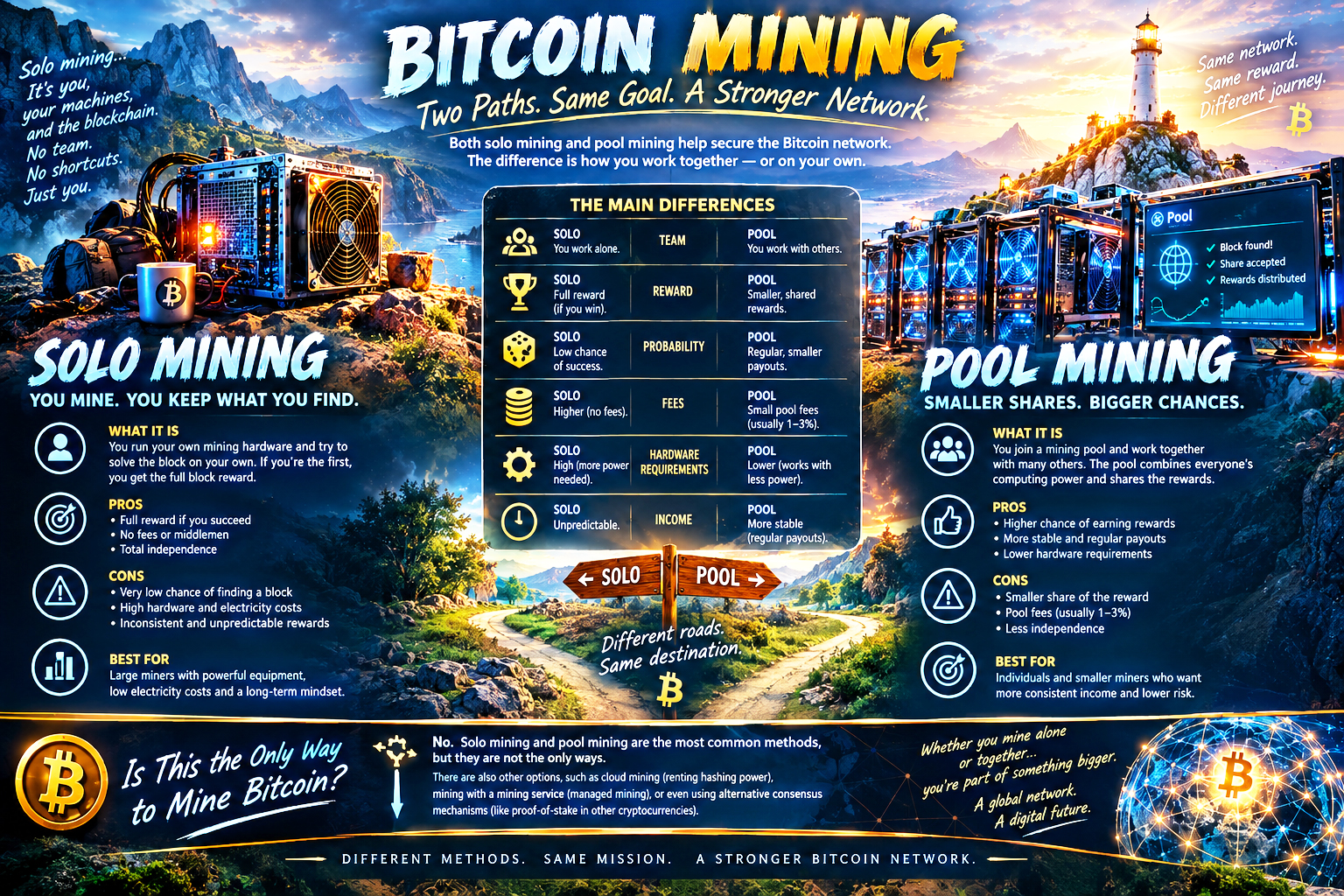
Solo mining means mining Bitcoin independently and keeping the entire block reward if successful, whereas pool mining combines resources with other miners to receive small, frequent payouts proportional to your hash rate.
Solo mining is:
- Independent connection: Hardware plugs straight into the Bitcoin network or a dedicated solo stratum
- Winner-take-all: You hit the jackpot or earn zero
- High odds against you: A single modern device faces a multi-decade wait on today’s massive network
Pool mining is:
- Shared power: Thousands pool hash rates to find blocks consistently
- Consistent revenue: Paid reliably for continuous contributions (shares)
- Operator fees: Pools take a tiny percentage cut (typically 1–3%) for organizing work
So, it all depends; both can be good options. Solo mining is more demanding and takes significantly longer, whereas pool mining is more stable and secure.
| Feature | 👤 Solo Mining | 🏊 Pool Mining |
|---|---|---|
| Payout frequency | Extremely rare (years/decades for small setups) | Daily or regular steady streams |
| Reward split | Keep 100% (3.125 BTC + fees) | Shared proportionally minus 1–3% pool fee |
| Risk & Variance | Maximum (all-or-nothing lottery) | Low/Moderate (predictable cash flow) |
| Ideal user | Industrial mega-farms or high-risk hobbyists | Beginners and standard hardware owners |
Let’s compare this to, say, placing a bet (on horse racing or anything else). You use a portion of your budget for the stake, and if you hit the jackpot, you take it all! Everything is great. But the odds are one against xx,xxx other bettors.
If, instead, you join a pool with others (some of whom might be really skilled at this), you can put up a significantly larger amount (and have a much better chance of winning), and then you share the winnings…
Lorem ipsum dolor sit amet, consectetur adipiscing elit. Ut elit tellus, luctus nec ullamcorper mattis, pulvinar dapibus leo.
Solo miner
If you’re mining solo it will take years, pool miners receive smaller, but steady payouts. In solo mining, a specific miner utilizes their very own hardware to try to fix the cryptographic challenge needed to add a new block to the Bitcoin blockchain. If successful, the solo miner gets the entire block incentive of 3.125 BTC, plus any kind of deal costs connected with that block. Nevertheless, the possibilities of successfully extracting a block solo are very reduced as a result of the high network difficulty and the enormous computational power needed.
Offered the challenges of solo mining, lots of miners choose to join mining pools, there can several miners integrate their computational sources to boost the possibility of extracting a block. When the pool effectively mines a block, the 3.125 BTC incentive is dispersed among all pool members in proportion to the computational power (hashrate) they contributed. This approach gives miners with more regular, albeit smaller sized, payouts.
To extract bitcoin successfully, you’ll need effective computers called ASICs (application-specific integrated circuits). These are made especially for mining and much outperform routine computer systems or graphics cards. Popular versions consist of the Antminer S19 Pro (110 TH/s) and WhatsMiner M30S++ (112 TH/s). Expect to spend anywhere from $ 1,400 to $ 7,000 or more depending on the version and problem.


To be profitable, you need:
- Reliable hardware: ASIC miners can cost thousands of pounds, however they’re needed to contend.
- Rates: mining is energy-intensive. If your power is expensive, your profits can vanish
- a good location: nations with cooler climates and low-cost power (like Iceland or parts of Canada) are much more good
- a reputable mining pool: signing up with a pool increases your chances of making routine rewards. Allow’s simplify with an instance:.
Due to the fact that solo mining is very competitive and statistically unlikely to do well, many miners sign up with mining pools. When the pool efficiently mines a block, the incentive is divided among participants based on just how much they contributed. Leading mining pools consist of F2Pool, AntPool, and ViaBTC.
Bitcoin mining can be rewarding, however, it depends on a few crucial aspects. Initially, allow’s begin with the possible advantage. When you effectively mine a block, you obtain a block benefit– currently 3.125 BTC– plus deal fees. At today’s costs, that deserves a considerable amount of money. But actually earning that benefit needs major investment.
Imagine your ASIC miner consumes 3,000 watts of power and runs 24/7. That has to do with 72 kWh each day. At $0.15 per kWh, your day-to-day electricity cost is over $13. Multiply that by thirty day, and you’re spending $400/month just on power, not consisting of equipment or maintenance costs. If your miner gains $500 in bitcoin that month, your revenue is $132. But if Bitcoin’s price declines, or your devices ends up being out-of-date, that margin might vanish. Booth in short and long, mining can be rewarding, yet, it’s not easy.
Since June 13, 2025, the block benefit is 3.125 BTC. This amount cuts in half about every four years in an occasion called the halving. The halving helps regulate bitcoin’s supply and adds to its scarcity in time. Along with the block incentive, miners also gather transaction fees from the payments included in each block. As block rewards decrease in future halvings, these deal costs will play a bigger function in incentivising miners.
some Key facts:
- The block benefit began at 50 BTC in 2009
- It cut in half to 25 BTC in 2012, then to 12.5 BTC in 2016, and 6.25 BTC in 2020
- The most current halving in April 2024 decreased it to 3.125 BTC
How many bitcoins can be extracted? The optimum supply is dealt with at 21 million bitcoins.
- Over 19.6 million have already been mined
- The last bitcoin will likely be mined by 2140
- Block compensates halve every 210,000 blocks (about every 4 years)
Eventually, purchase costs will be miners’ only revenue source.

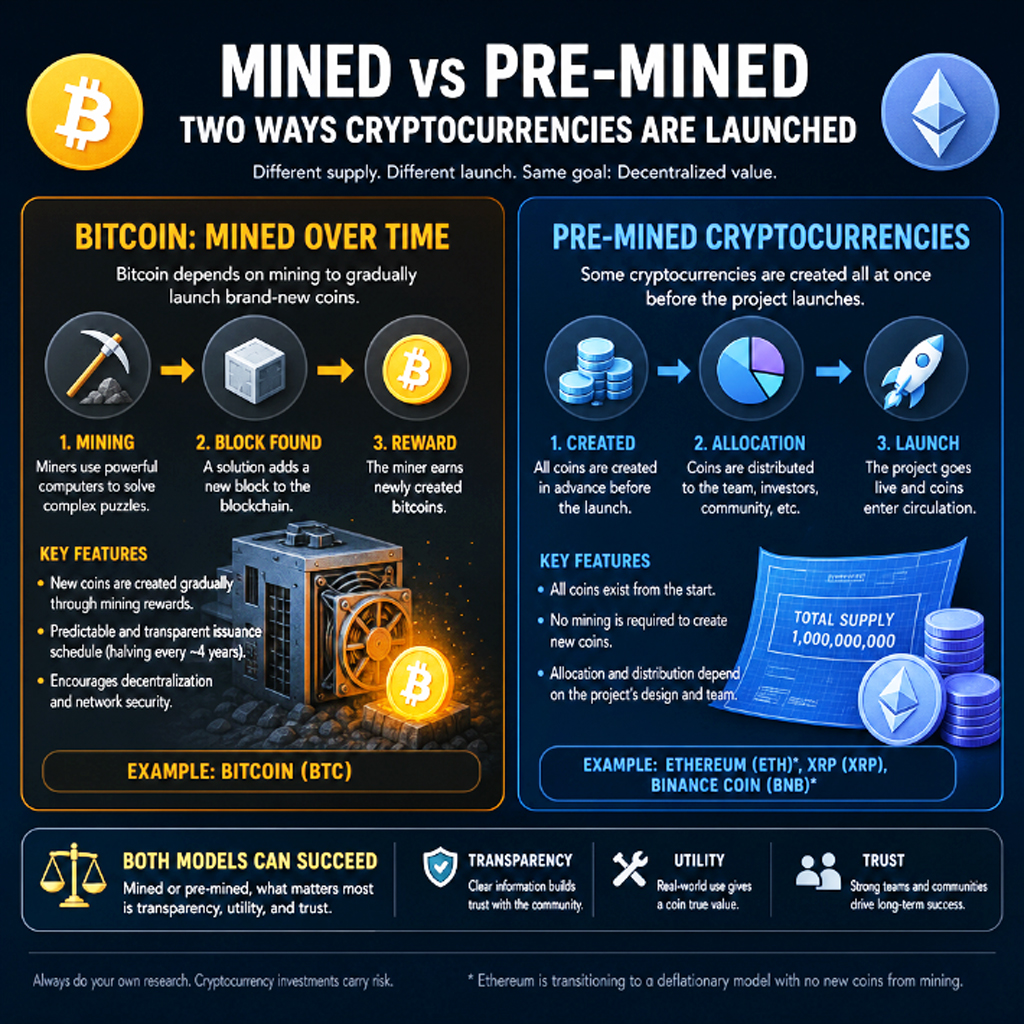
While Bitcoin depends on mining to gradually launch brand-new coins, some cryptocurrencies take a different strategy. These are referred to as pre-mined cryptocurrencies.
Some cryptocurrencies do not require traditional mining. Instead, a portion of their total supply is created and distributed before the coin is officially launched. These are called pre-mined cryptocurrencies.
Pre-mined cryptocurrencies are created and distributed to developers or early investors before public launch, requiring an investment strategy different from proof-of-work mining
In a pre-mined cryptocurrency, a part (or all) of the overall supply is developed prior to the network is launched. These coins are often dispersed to early capitalists, developers, or neighborhood members through methods like first coin offerings (ICOs), airdrops, or group allocations.
These are the Major Pre-Mined Cryptocurrencies
These networks of pre-mined cryptocurrencies create a portion or all of their token supply before public launch example;
- Ethereum (ETH): 72 million coins created for early ICO funders
- Ripple (XRP): Entire initial supply generated prior to network release
- Cardano (ADA): Over 25 billion tokens allocated at genesis
- Solana (SOL): Initial supply distributed to support ecosystem growth
- Binance Coin (BNB): Total supply of 200 million tokens distributed via ICO before platform launch.
- Polkadot (DOT): Initial supply of 1 billion tokens created at genesis for early investors and network operations
- IOTA (MIOTA): 100% of the total token supply was completely pre-mined at genesis
Pre-mining can increase network advancement and funding, yet it also requires a high degree of depend on– since the makers manage the first circulation. On the other hand, Bitcoin’s mining-based issuance design guarantees coins are gained with computational job, making the process transparent and decentralised.
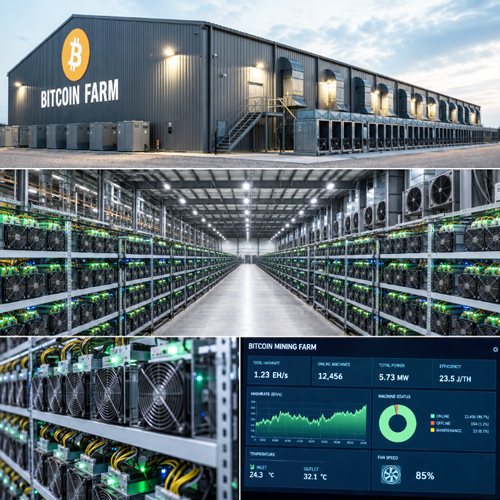
There are other players in the market as well: Bitcoin farms. These are large industrial facilities housing hundreds or thousands of specialized computers that run 24/7 to mine Bitcoin. These facilities utilize numerous, highly powerful ASIC machines working in tandem, either to mine new digital coins or to earn rewards through decentralized finance (DeFi) lending.
Bitcoin farms are indispensable to the BTC ecosystem. They not only process transactions but also contribute significantly to the creation of new coins. This process, termed proof of work, demands considerable computing power and energy resources.
A bitcoin farm resembles a large storehouse loaded with powerful computers that are all mining bitcoin all the time. These ranches are constructed to run hundreds or perhaps countless mining makers 24/7.
The objective of a bitcoin farm is to make as lots of bitcoins as feasible by integrating solid hardware, cheap electrical energy, and good cooling. Due to the fact that mining takes a lot of energy, ranches are generally found in position where power is inexpensive and the environment is normally trendy, like Iceland or Scandinavia.
Other top countries for mining are: the US (Texas, Georegia), and Canada (Quebec, Alberta), Paraguay, (Extremely low electricity costs); Ethiopia, (Very low cost per mined coin. Expanding industrial capacity. Emerging African mining hub)
These farms make it difficult for small, specific miners to compete. Consequently, Bitcoin mining is today primarily carried out by professional players with substantial resources.
The world’s largest Bitcoin mining facility is operated by Riot Platforms, in Navarro County in Texas, United States.
The history of Bitcoin farms dates back to the very inception of Bitcoin, a digital currency that was, and remains, revolutionary. It was launched in 2009 by Satoshi Nakamoto.
Can I as a private person mine bitcoin? Technically, indeed, however practically, it’s tough without inexpensive electrical energy, cooling infrastructure, or advanced ASIC tools. Novices may discover it less complicated to get or trade bitcoin as opposed to mine it. Well, what is the future of bitcoin mining then? As block incentives shrink, mining will depend more on transaction charges. Future advancements will include:
- greener mining technology
- regulation on power usage
- feasible change towards crossbreed consensus models
- much faster, more reliable ASICs
Mining’s function is evolving, yet it remains essential to Bitcoin’s safety. Bitcoin mining is a complex, capital-intensive activity. It can be rewarding, however likewise needs considerable resources, research study, and risk management.
This information provides a general overview of Bitcoin mining, hat it is, how it works, what is required, and so on. However, if you see a potential source of income here and would like to know more, please contact us below.
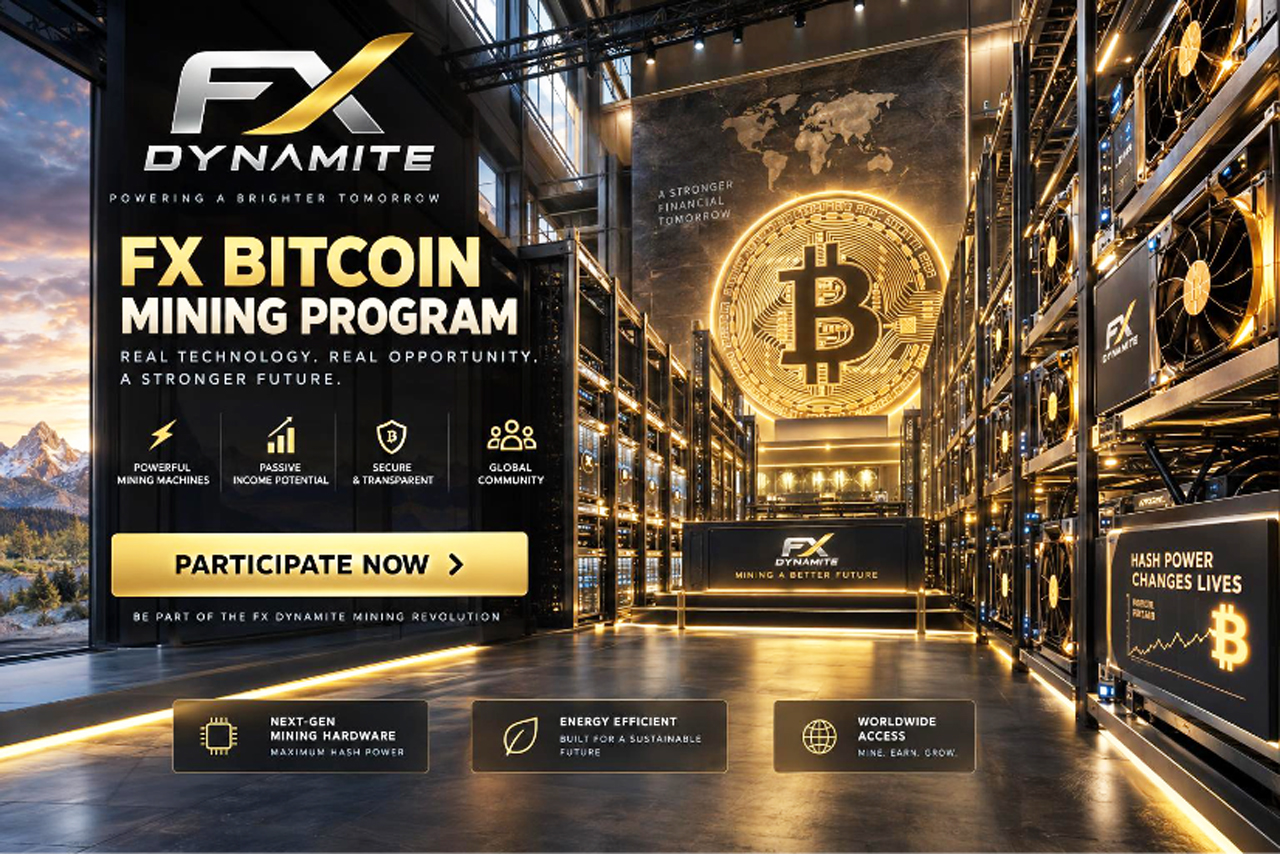
FX dynamite Bitcoin makes it simple!: Just buy/(rent) the ASICs machine which is configured by our tech-guru! And do nothing, just follow the income coming, every day. Over a 4-year horizon, a single top-tier Bitcoin mining ASIC machine can bring in roughly $11,000 to $33,000 in gross revenue.
When it comes to the economic lifespan of miners, and how long they can generate more value than they cost, it depends on a few factors: electricity rates, the price of Bitcoin, network difficulty, total hash rate, and your machine’s efficiency (J/TH). However, you don’t need to worry about any of that; everything is already set up for you.
As for the machines, most ASIC miners can operate for 5 to 7 years with proper maintenance. The most common figure, and the one you can base your calculations on, is around 4 years. Some older models can still be found in various parts of the world, and they remain in operation.
Please check out fxdynamite[.] com/signup. Fill out the form and submit it, and we will contact you and provide guidance.
From the First Step to the Next Horizon
FX dynamite
Inspired by our work?
Signup! Together, we will build your ideal space

Premium Supplies
High-quality products and resources. Carefully selected premium solutions. Quality you can trust. Everything you need to succeed!
Up-to-Date Trends
Stay ahead of the latest trends. Discover new tools and opportunities. Fresh ideas for a changing market. Always evolving with the digital world.
© 2026 Exclusive interior. All Rights Reserved.