 skypilot
 skydiver

 bluethunder
Introduction: Who Actually Pays the People Mining Bitcoin?
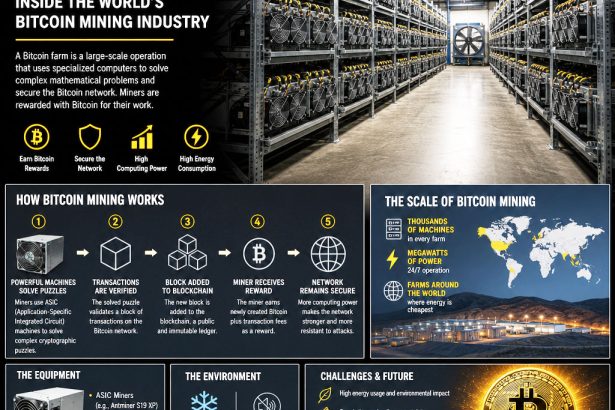
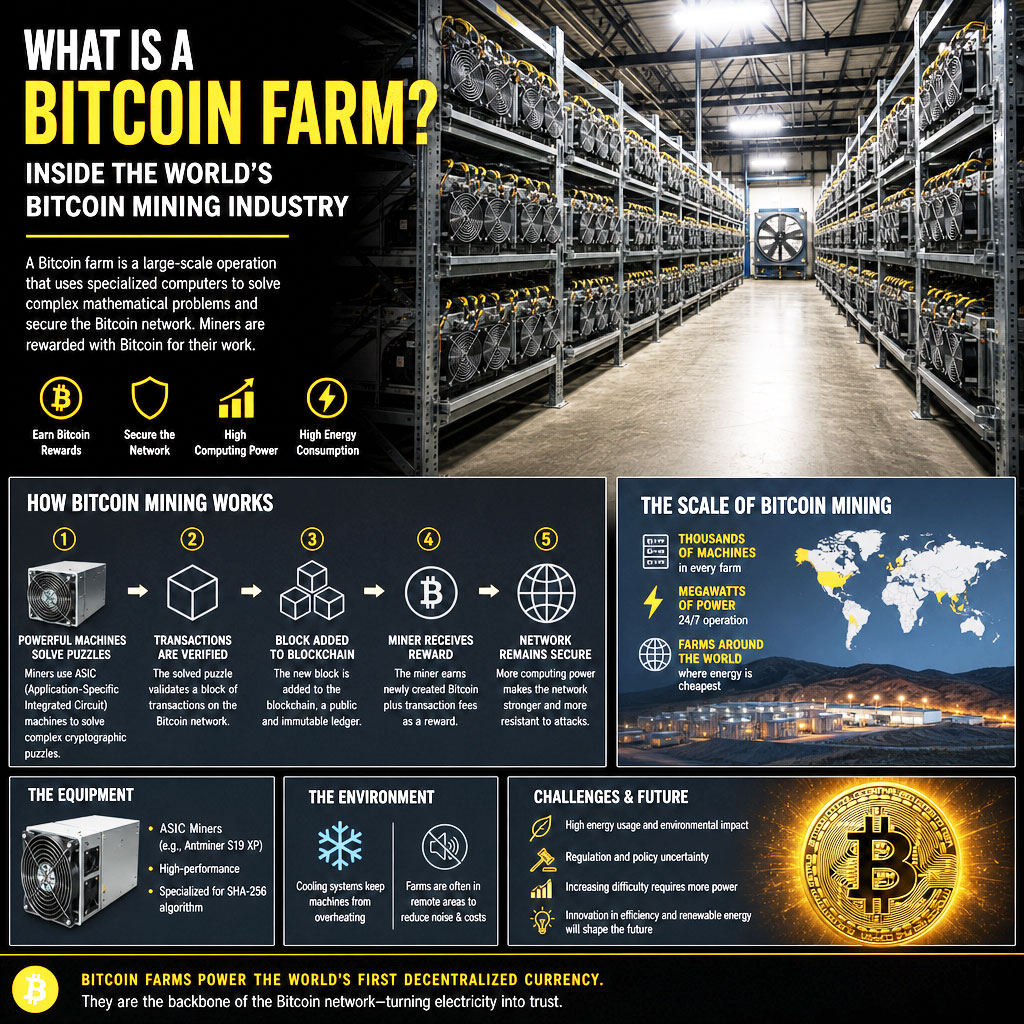
Bitcoin mining is a business that can involve enormous investments in computers, electricity, cooling systems and industrial facilities. Large mining companies operate thousands of specialised machines, while smaller participants contribute their computing power through mining pools. But one question often arises among people discovering Bitcoin for the first time:
Who actually pays Bitcoin miners?
Is it the Bitcoin network? Is there a company responsible for transferring the money? Do Bitcoin users pay the miners directly? And where do the bitcoins that miners receive come from?
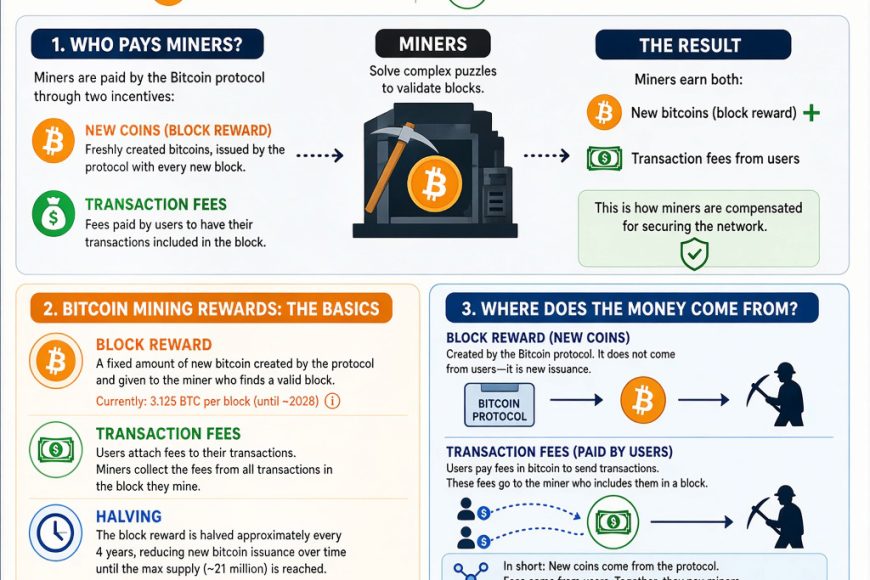
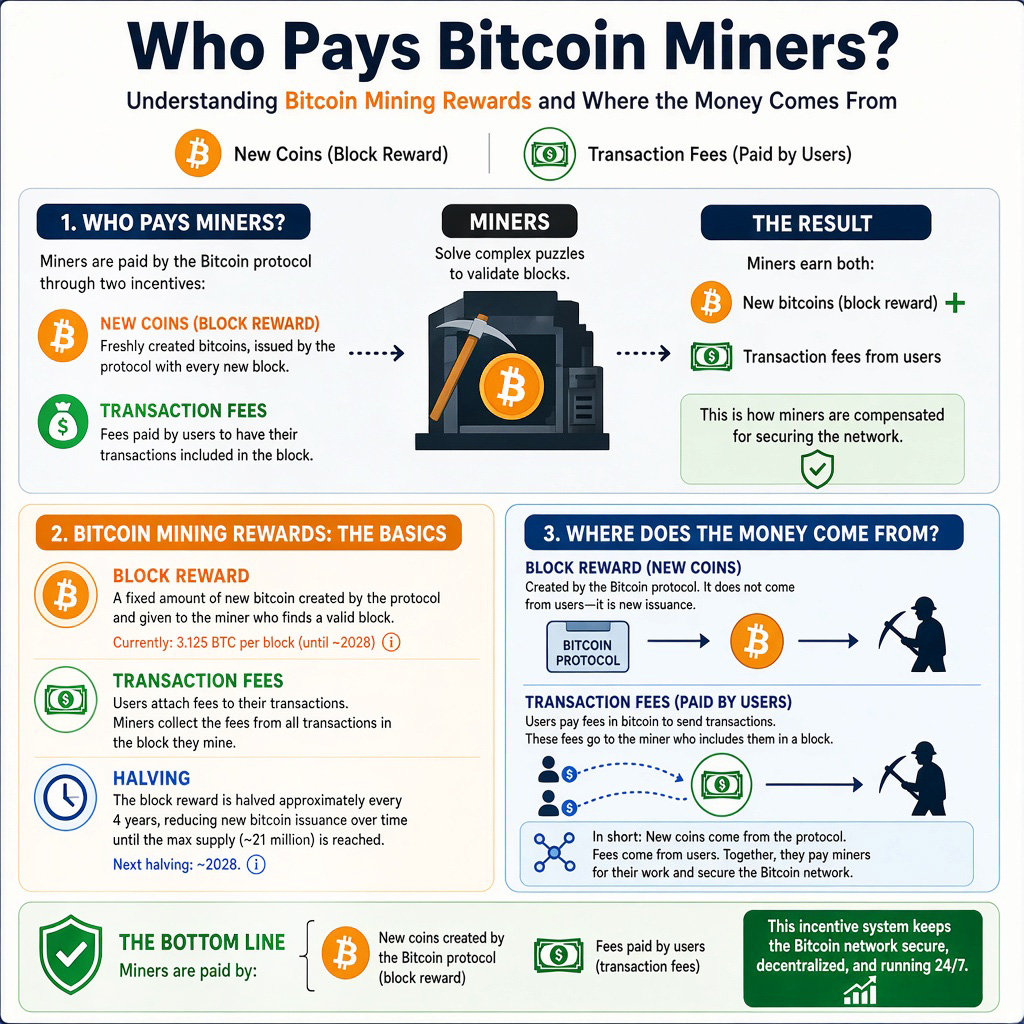
The answer is particularly interesting because Bitcoin does not have a central organisation responsible for paying miners. Instead, the Bitcoin protocol establishes a system of incentives that rewards miners for successfully producing valid blocks. This system combines newly created bitcoins with transaction fees paid by users.
In this article, we explain how Bitcoin mining rewards work, where the money comes from and why miners are economically motivated to maintain the network.
Who Pays Bitcoin Miners?
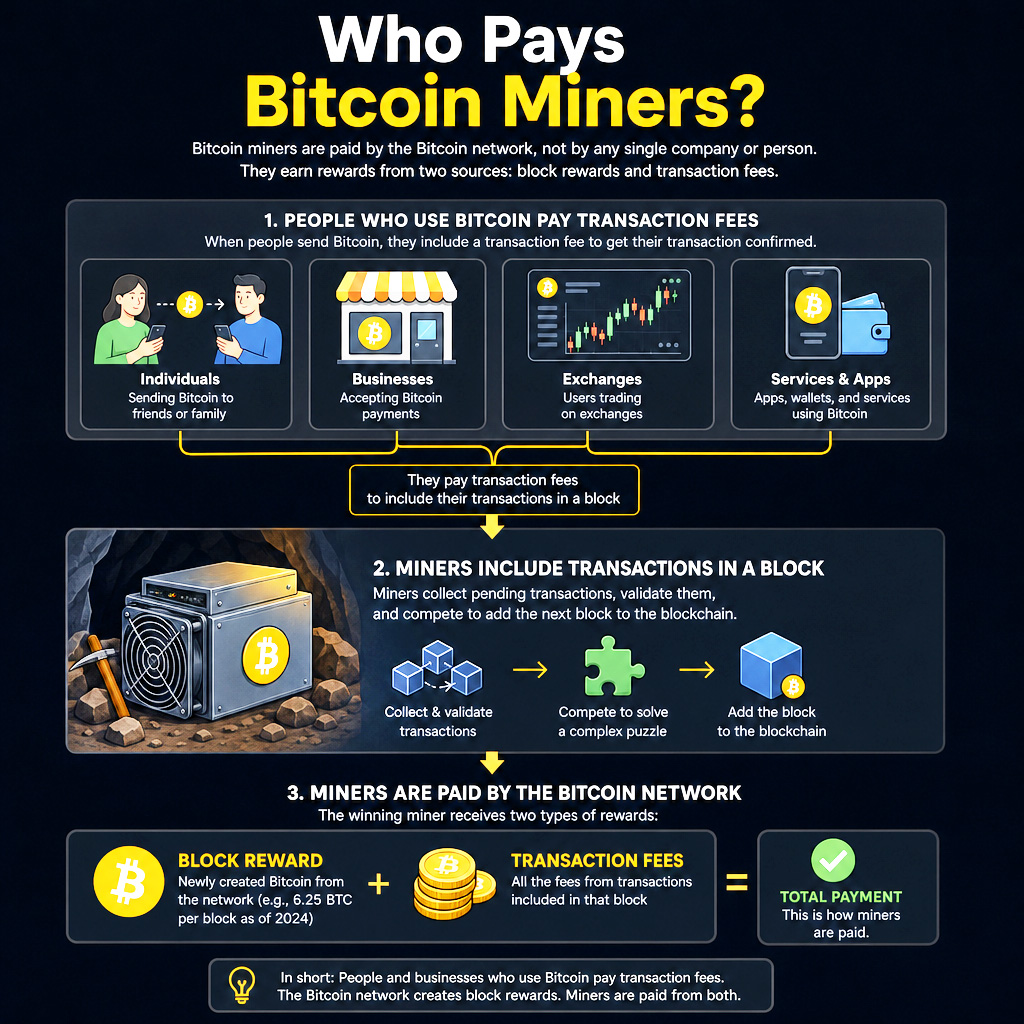 Bitcoin miners are not paid by a bank, government or central Bitcoin company. Their rewards are created and distributed through the Bitcoin protocol. Whenever a miner successfully produces a valid block, the miner can include a special transaction known as a coinbase transaction.
This transaction allows the miner to claim:
- The permitted block subsidy, consisting of newly issued bitcoins.
- The transaction fees from the transactions included in the block.
The Bitcoin network’s nodes independently verify that the miner has not claimed more than the protocol allows. This means that miners cannot simply decide to pay themselves unlimited amounts of Bitcoin. The rules are enforced by the software operated by network participants.
Where Do Newly Created Bitcoins Come From?
One of Bitcoin’s most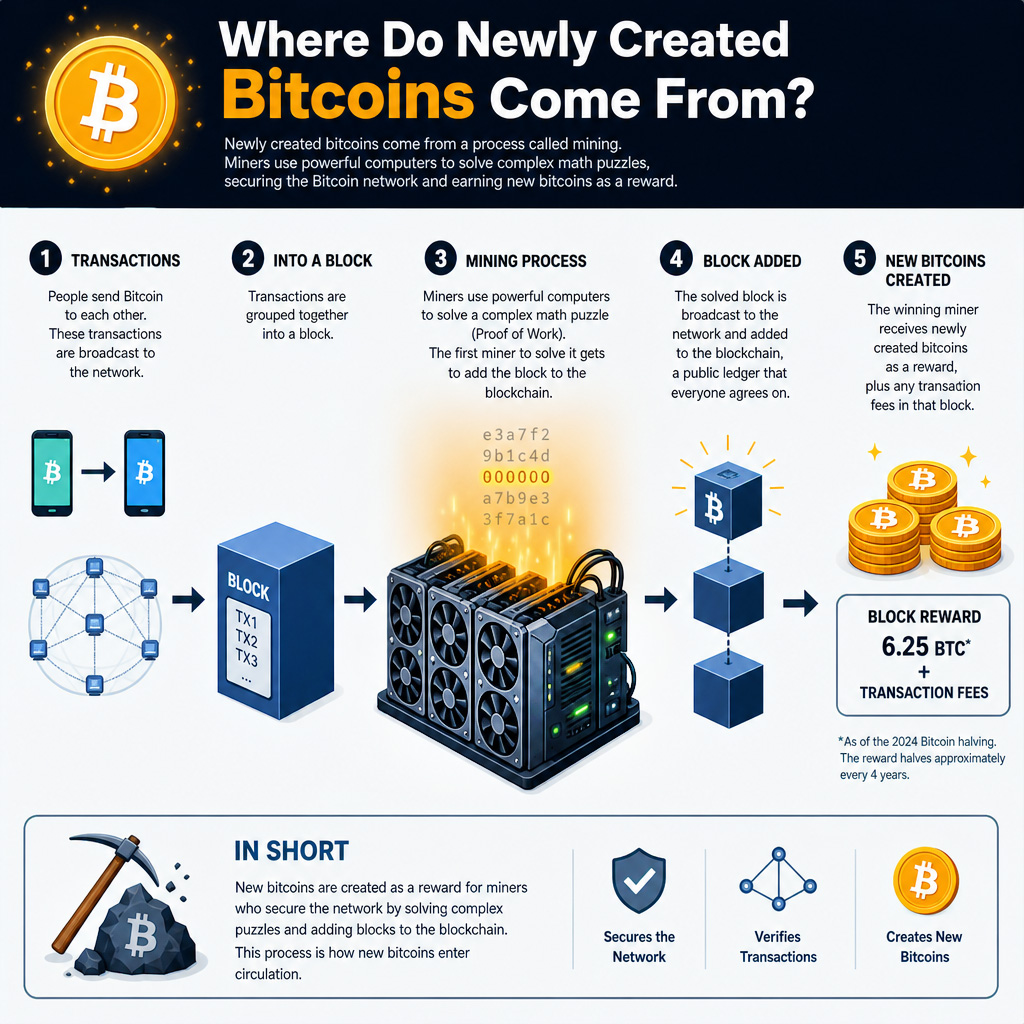 important features is its predetermined monetary supply. Unlike traditional currencies, Bitcoin is designed with a maximum supply of approximately 21 million coins.
New bitcoins enter circulation through mining rewards. When Bitcoin launched in January 2009, the block subsidy was 50 BTC per block. However, the subsidy is automatically reduced by half every 210,000 blocks. This process is known as the Bitcoin halving. The historical schedule is:
Halving Year Block subsidy
Bitcoin launch 2009 50 BTC
First halving 2012 25 BTC
Second halving 2016 12.5 BTC
Third halving 2020 6.25 BTC
Fourth halving 2024 3.125 BTC
Fifth halving Expected 2028 1.5625 BTC
The dates of future halvings are estimates because the mechanism is based on block height rather than a fixed calendar date. This gradual reduction in new issuance is designed to continue until the block subsidy eventually becomes zero.
Why Does Bitcoin Pay Miners?
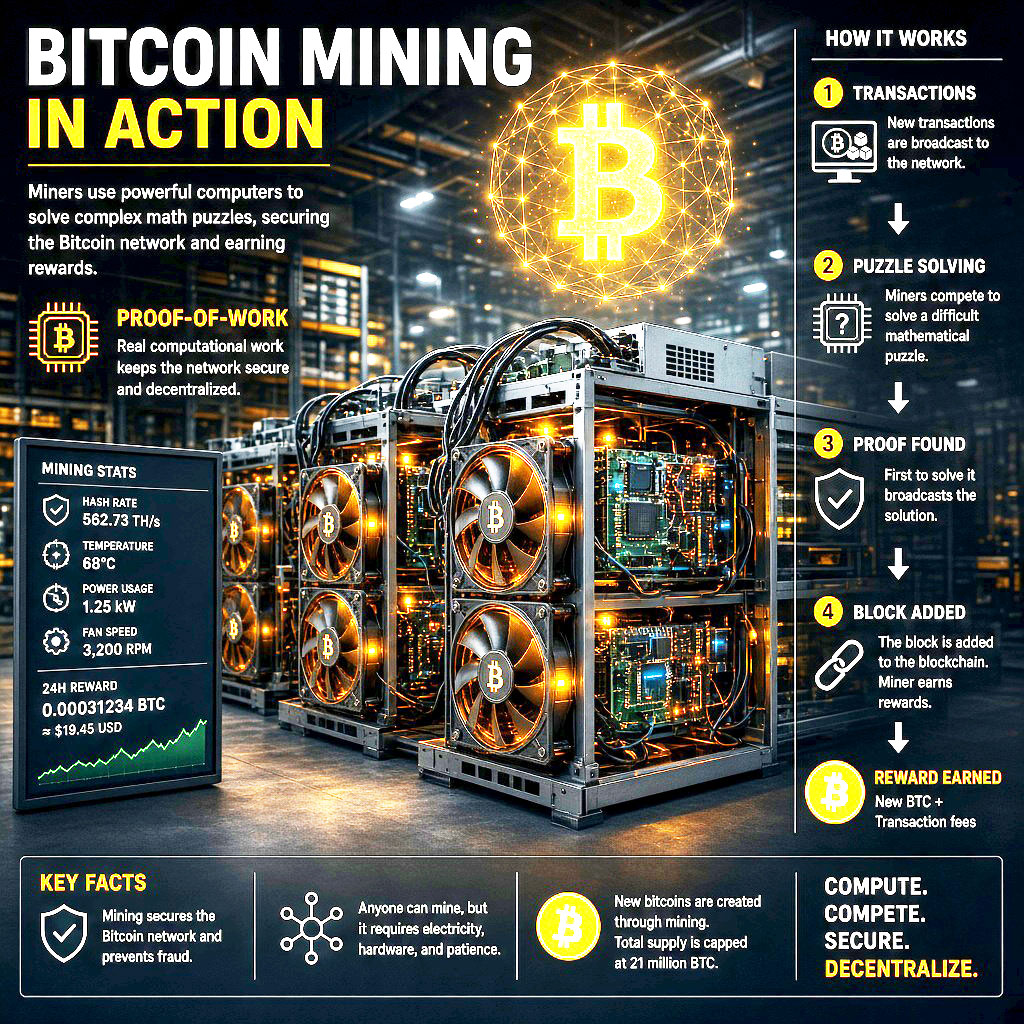
The mining reward exists because Bitcoin needs an economic incentive to encourage participants to contribute computing power to the network. Mining requires real resources.
Machines consume electricity, generate heat and require maintenance. Industrial facilities also involve infrastructure, personnel, security and operational expenses. Without an economic incentive, there would be less reason for independent participants to invest in the resources needed to secure the network.
Mining Rewards Encourage Network Security
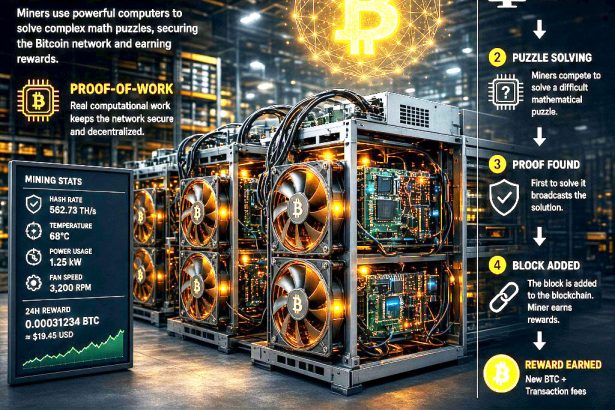
Bitcoin uses Proof of Work to make it expensive to produce blocks and attempt to manipulate the blockchain. Miners compete to find a valid cryptographic hash. The successful miner receives the right to produce the next block and claim the permitted reward.
This creates a financial incentive to participate honestly. The reward also provides a way to distribute new bitcoins without requiring a central organisation to issue them. This was part of the original design described in Satoshi Nakamoto’s Bitcoin whitepaper.
What Are Bitcoin Transaction Fees?
 Newly issued bitcoins are only one component of miner income. The second component consists of transaction fees. Whenever someone sends Bitcoin, they can attach a fee to the transaction. This fee is paid to the miner who includes the transaction in a successfully mined block.
The fee is generally determined by the transaction’s demand for block space rather than simply the amount of Bitcoin being transferred. For example, a relatively small payment may require a higher fee than a larger payment if it competes for limited block space during a period of high network demand.
Why Do Transaction Fees Exist?
Bitcoin blocks have limited capacity. When many users want their transactions confirmed, demand for available block space can exceed supply. Users can compete for inclusion by offering higher fees.
Miners have an economic incentive to select transactions that provide attractive fee revenue. This creates a market for block space.
Who Receives the Transaction Fees?
The miner who successfully produces the block receives the fees associated with the transactions included in that block. If the miner operates independently, the reward belongs to that miner or mining operation.
If the miner participates in a mining pool, the pool generally receives the block proceeds and distributes payments according to its reward-sharing system.
How Much Does a Bitcoin Miner Earn?
A miner’s income depends on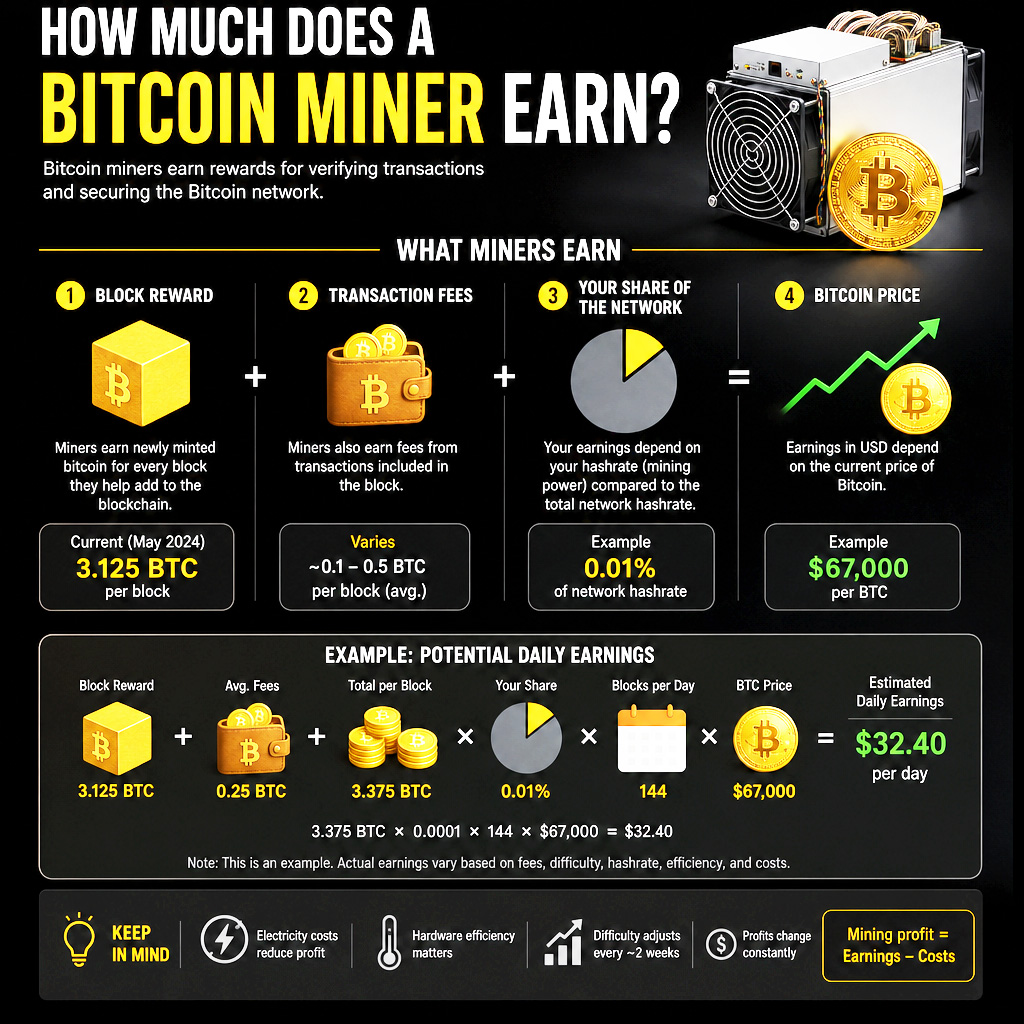 several factors. The most important include:
- The current block subsidy.
- Transaction fees.
- The miner’s share of total network hashrate.
- Mining pool fees.
- Electricity costs.
- Hardware efficiency.
- Maintenance and infrastructure expenses.
- The market value of Bitcoin.
Consider a simplified example. Suppose a miner successfully produces a block while the subsidy is 3.125 BTC. If the included transactions generate an additional 0.20 BTC in fees, the total block reward is:
3.125 BTC + 0.20 BTC = 3.325 BTC The miner can claim the permitted subsidy and fees through the coinbase transaction. The actual monetary value depends on the Bitcoin market price. Importantly, this is the reward for producing an entire block, not the typical income of an individual mining machine.
What Is a Bitcoin Mining Pool?
Mining pools allow individual miners to combine their computing power. This is important because the Bitcoin network is extremely competitive. An individual miner operating a single machine may have a very small probability of independently producing a block.
By joining a mining pool, the participant contributes computing power alongside other miners. If the pool successfully mines a block, the proceeds are distributed among participants according to the pool’s payout method.
How Are Mining Pool Payments Calculated?
Mining pools generally use submitted shares to estimate how much work each participant has contributed. A share is evidence that a miner has performed a certain amount of computational work, although most shares are not difficult enough to qualify as valid Bitcoin blocks.
Different pools use different payment systems, including:
- Pay Per Share (PPS).
- Full Pay Per Share (FPPS).
- Pay Per Last N Shares (PPLNS).
Each system distributes mining income differently and may involve different fees and payment conditions.
Why Do Miners Join Pools?
Mining pools can provide more predictable payments. Rather than waiting for a single machine to discover a full block, participants receive smaller distributions based on the pool’s overall performance and their contributed work. This reduces income variability, although it does not eliminate the risks of mining profitability.
What Happens to Miners When Bitcoin’s Block Reward Gets Smaller?
This is one of the most important questions concerning the future of Bitcoin mining. Every halving reduces the number of newly issued bitcoins available to miners. As a result, transaction fees are expected to become increasingly important as a source of mining revenue.
The transition will happen gradually over many decades. The next halving, expected around 2028, will reduce the subsidy from 3.125 BTC to 1.5625 BTC per block. Miners will therefore need to consider several factors:
- The market value of Bitcoin.
- Electricity prices.
- Hardware efficiency.
- Transaction fee revenue.
- Network competition.
- Operational expenses.
Mining companies that cannot operate economically may eventually shut down or sell their equipment. Others may remain competitive through more efficient hardware and access to lower-cost electricity.
Do Bitcoin Miners Create Value?
The economic value of mining is connected to the services miners provide to the network. They contribute computing power to the Proof of Work system, help order transactions and make historical manipulation more expensive. However, the value of these services is a matter of economic and technological debate.
Supporters argue that mining provides an important foundation for Bitcoin’s decentralised security. Critics point to the electricity consumption, environmental impact and concentration of industrial mining. Both perspectives are important when evaluating the long-term economics of Bitcoin.
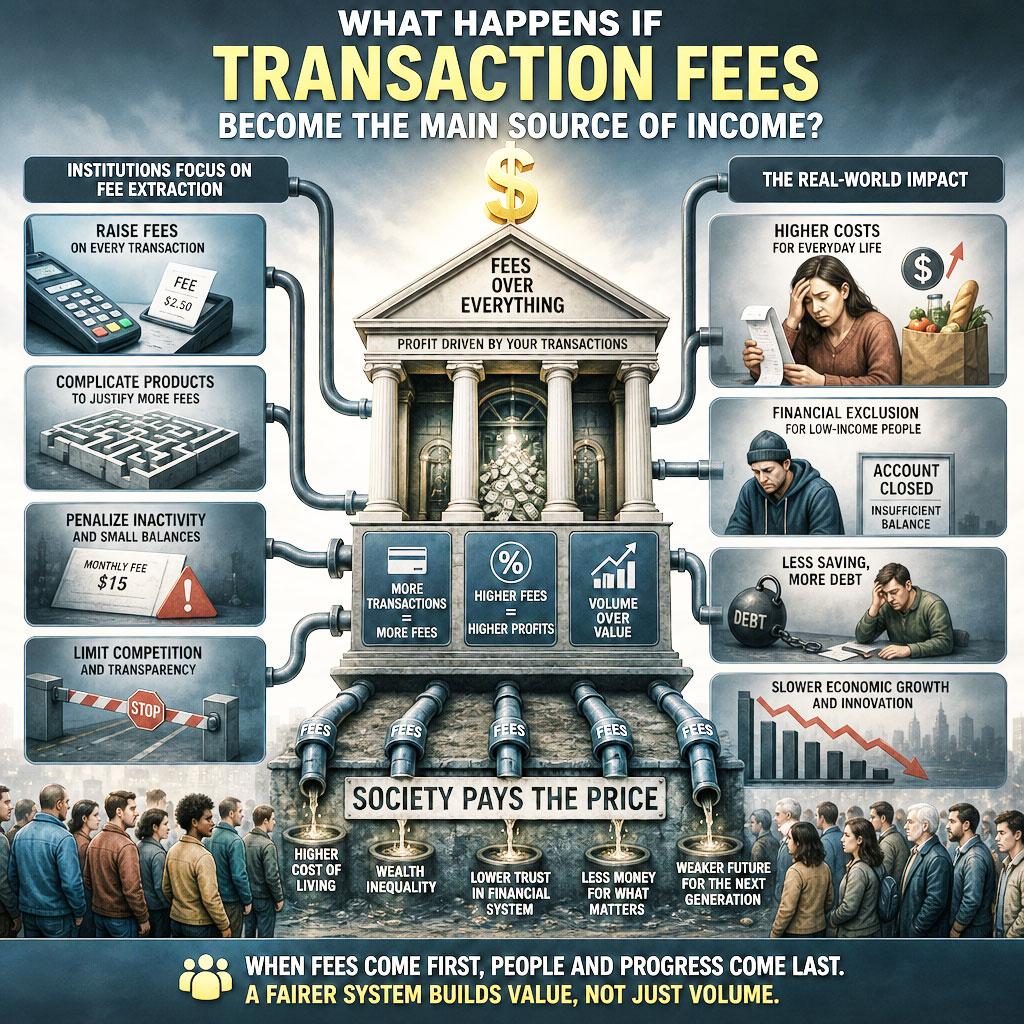
What Happens If Transaction Fees Become the Main Source of Income?
Eventually, the block subsidy will become so small that it will no longer provide meaningful revenue. At that stage, miners will rely primarily on transaction fees. This creates an important economic question. Will users be willing to pay sufficient fees to support the computing power required to secure the Bitcoin network?
The answer will depend on future demand for Bitcoin transactions, the development of payment technologies and the willingness of users to pay for on-chain settlement. It is an important subject of ongoing discussion within the Bitcoin community.
Conclusion: Bitcoin Mining Rewards Are Built Into the Protocol
Bitcoin miners are not paid by a central company or government. Their income comes from two sources: newly created bitcoins and transaction fees paid by users. This reward structure encourages participants to contribute computing power and helps secure the decentralised network. The system is designed to change gradually as the block subsidy decreases through successive halvings.
Over time, transaction fees are expected to become increasingly important. Understanding who pays miners and why they receive Bitcoin is essential for understanding the economic model behind the world’s best-known cryptocurrency.
Educational notice: Mining rewards are variable and depend on network conditions, Bitcoin prices and operating expenses. Participation in mining pools and mining operations involves financial and technical risks.