
 skypilot

 skydiver


 bluethunder
Introduction: Inside the World of Industrial Bitcoin Mining
When people hear the expression Bitcoin mining, they may imagine an individual sitting in front of a computer, running specialised software and earning cryptocurrency. Although this was closer to the reality during Bitcoin’s early years, the industry has changed dramatically.
Today, Bitcoin mining is a large international business involving industrial buildings, specialised computing equipment, substantial electricity consumption and sophisticated cooling systems. These operations are often referred to as Bitcoin farms, Bitcoin mining farms or Bitcoin mining facilities.
Some contain hundreds of machines, while the largest industrial operations can house thousands or even tens of thousands of specialised mining devices. But what exactly is a Bitcoin farm? How does one operate? Where are these facilities located? And how many Bitcoin farms exist around the world?
In this article, we explore the infrastructure behind industrial Bitcoin mining and examine how this growing industry operates.
What Is a Bitcoin Farm?
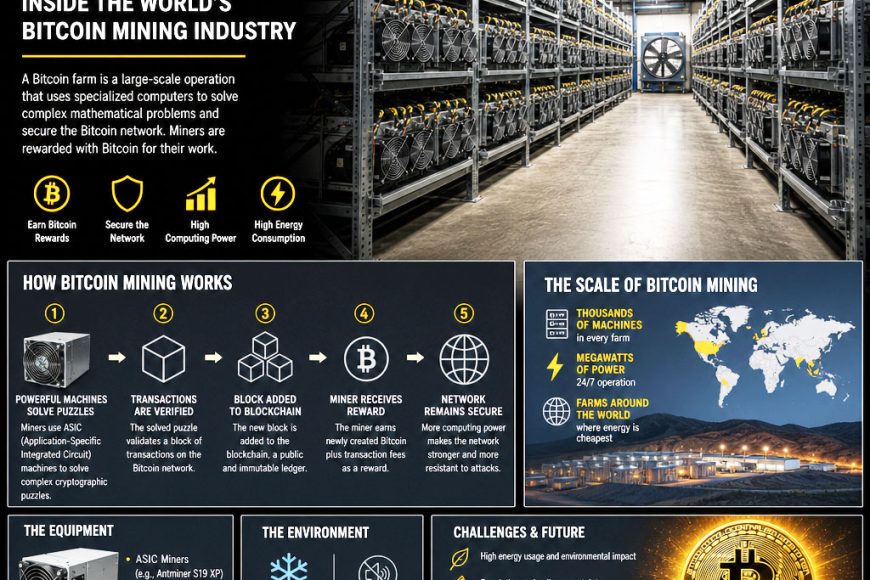
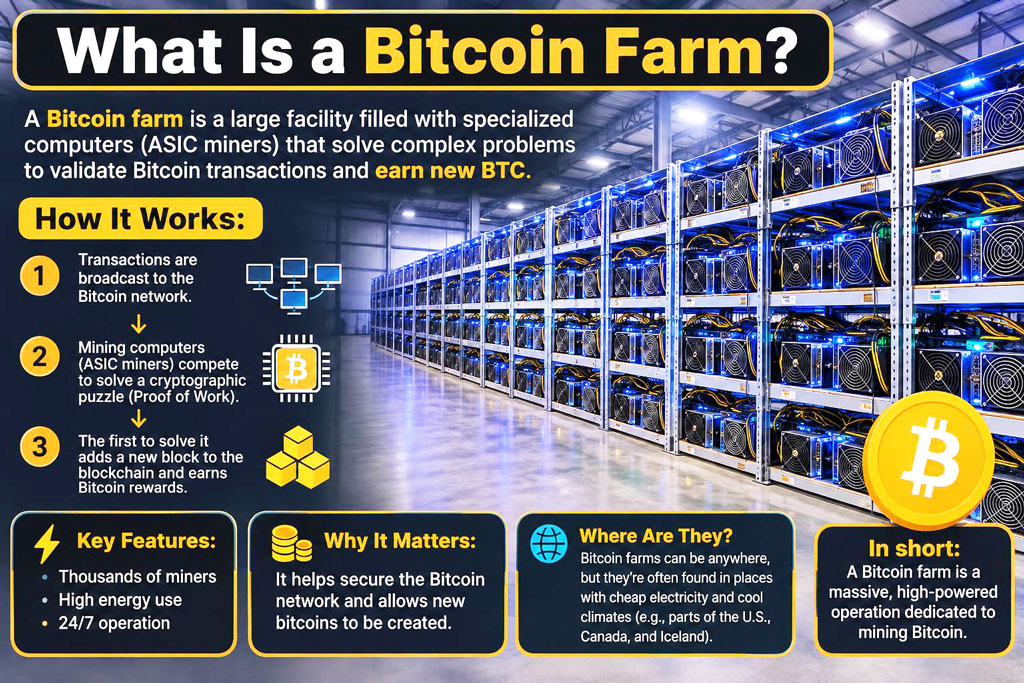 A Bitcoin farm is a facility containing specialised computers designed to mine Bitcoin. Instead of growing crops or raising livestock, these facilities produce computing power that is used to participate in the Bitcoin network.
The computers perform enormous numbers of cryptographic calculations in an attempt to discover valid blocks. A successful miner can receive newly issued bitcoins and transaction fees. A Bitcoin farm may operate in several different environments, including:
- Large industrial warehouses.
- Converted factories.
- Purpose-built mining buildings.
- Shipping containers.
- Modular data-centre facilities.
- Buildings located near power generation facilities.
The most important requirement is access to suitable electricity, reliable internet connectivity and infrastructure capable of operating large numbers of machines.
What Does a Bitcoin Mining Farm Look Like?
A professional mining facility is very different from an ordinary office or computer room. It typically contains rows of specialised mining machines connected to electrical infrastructure and cooling equipment. The facility may also include:
- Electrical distribution systems.
- High-capacity ventilation.
- Air filtration.
- Cooling equipment.
- Internet connectivity.
- Monitoring systems.
- Fire detection and safety equipment.
- Physical security.
Because mining machines operate continuously, electricity and cooling systems must be carefully designed. Even relatively small interruptions can affect productivity and profitability.
What Equipment Is Used in a Bitcoin Farm?
The most important component of a Bitcoin farm is its mining hardware. Modern Bitcoin mining primarily relies on Application-Specific Integrated Circuits, commonly known as ASICs. These machines are designed specifically to perform SHA-256 calculations.
ASIC Mining Machines
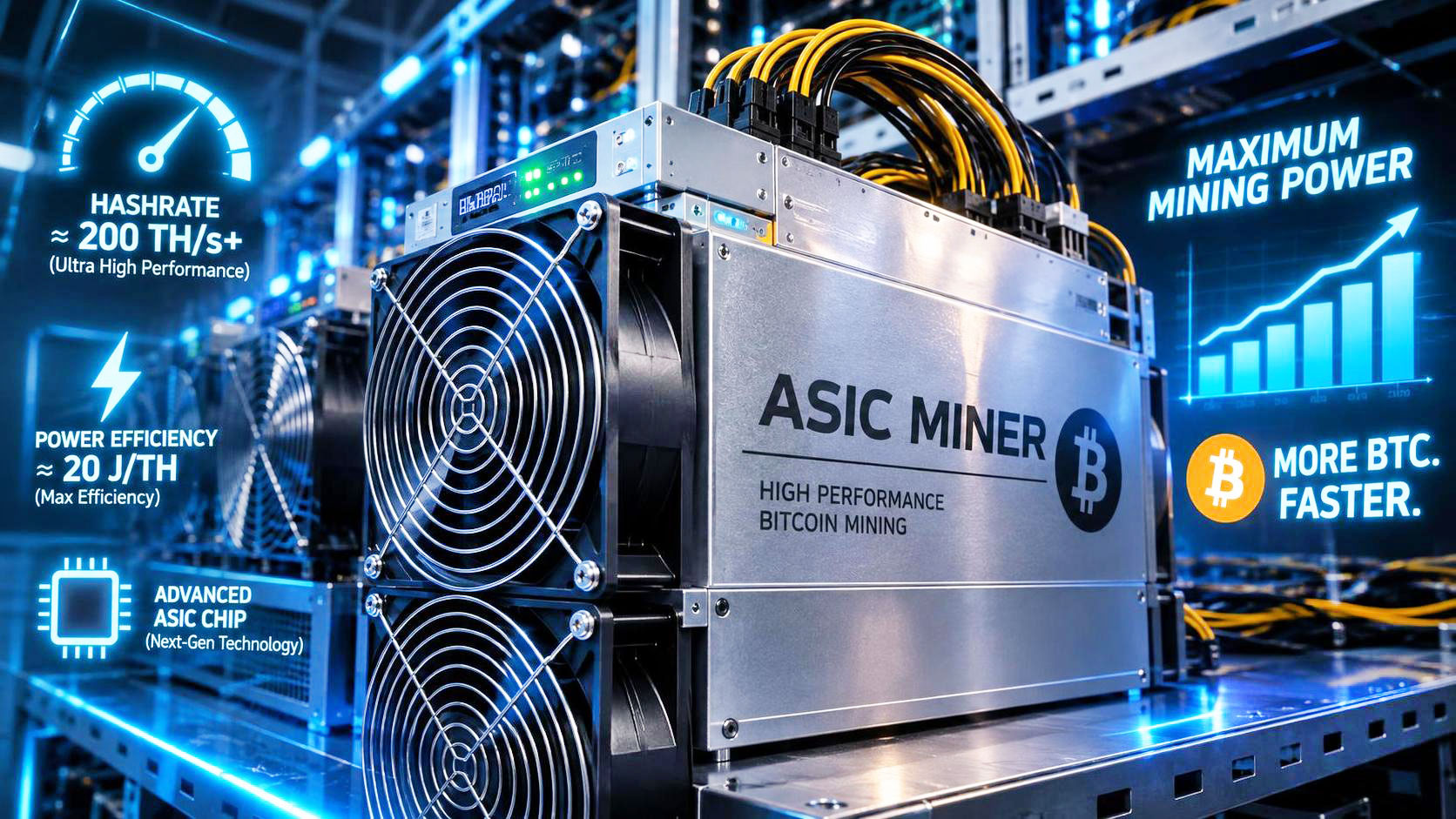 ASIC machines are considerably more specialised than ordinary computers. They are built to perform one particular category of computational work efficiently. Their performance is generally measured in terahashes per second.
For example, a hypothetical machine producing 200 TH/s performs approximately 200 trillion hashes every second. Large mining farms operate many machines simultaneously to increase their total computing power.
Electrical Infrastructure
Mining machines consume considerable amounts of electricity. A facility containing thousands of devices requires electrical infrastructure capable of supplying substantial and consistent power. This may include:
- High-voltage connections.
- Transformers
- Distribution panels.
- Power management systems.
- Backup infrastructure.
Electricity availability and cost are among the most important factors determining whether a mining facility can operate profitably.
Cooling and Ventilation
Mining hardware produces considerable heat. If temperatures become too high, machines may reduce their performance, experience failures or shut down. Consequently, industrial Bitcoin farms require effective cooling systems.
Some use large ventilation systems that move external air through the facility. Others use liquid cooling or immersion cooling technologies. The appropriate system depends on climate, hardware specifications, electricity costs and facility design.
How Does a Bitcoin Farm Make Money?
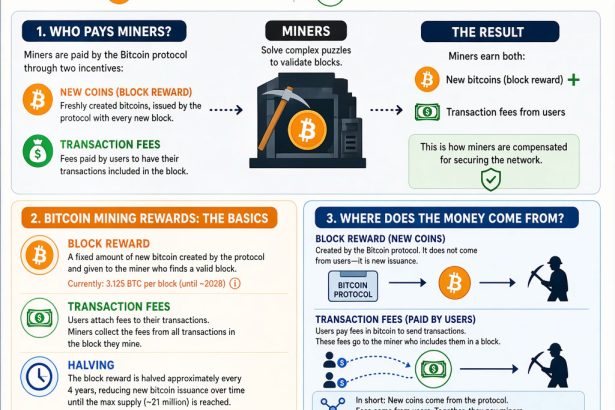
A Bitcoin farm generates revenue by contributing computing power to the Bitcoin network. Most industrial operators participate in mining pools. The farm connects its machines to a pool, which coordinates mining activity and distributes earnings according to the computing power contributed.
When the pool successfully mines a block, it receives the block subsidy and transaction fees. These proceeds are distributed among participating miners according to the pool’s payment arrangements.
The Main Expenses of a Bitcoin Farm
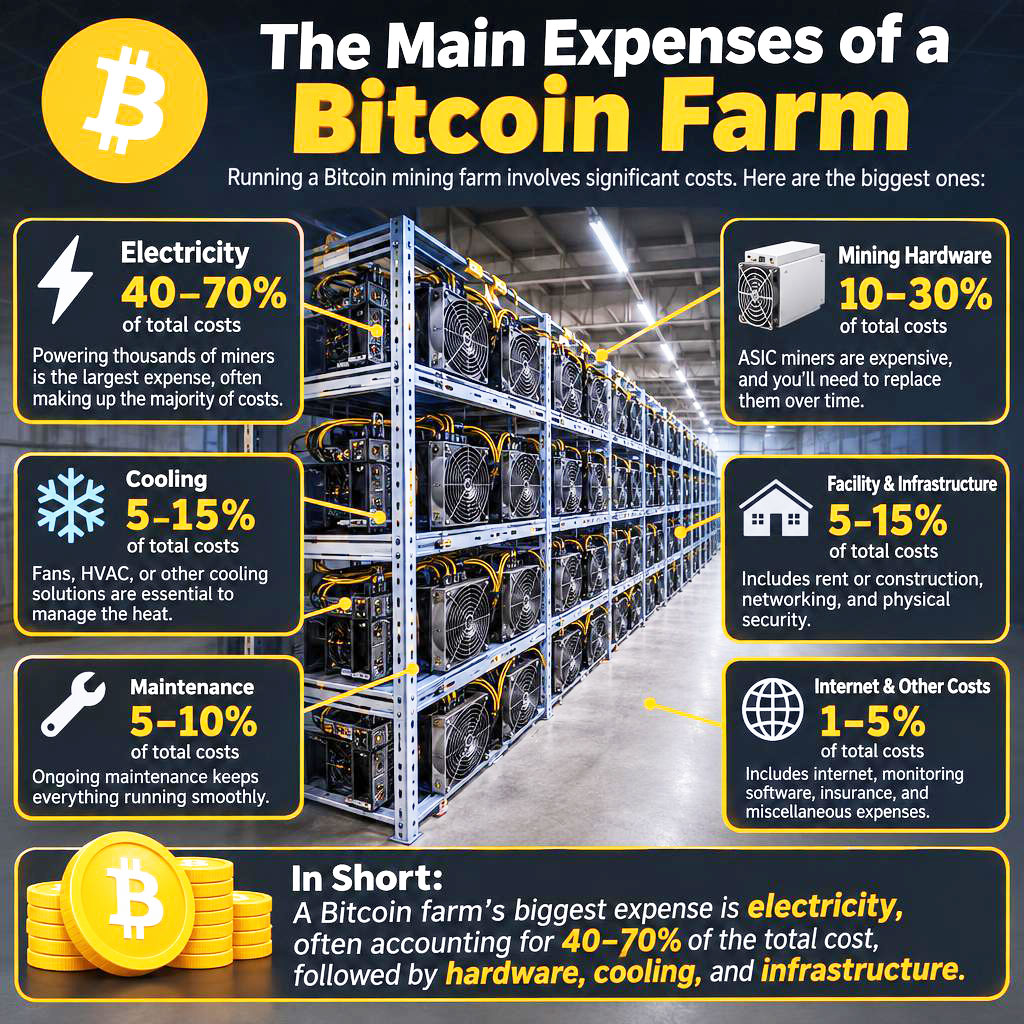 Although mining can generate Bitcoin revenue, operating a mining facility is expensive. The principal expenses include:
- Electricity: Usually one of the largest ongoing operating expenses.
- Hardware: ASIC machines require substantial upfront investment and eventually become less competitive as technology develops.
- Cooling: Ventilation and cooling systems consume additional electricity.
- Maintenance: Machines require monitoring, repairs and replacement components.
- Personnel: Larger operations need technical staff, electricians and facility managers.
- Building and infrastructure: Industrial premises, electrical connections and networking equipment all involve costs.
The relationship between these expenses and mining revenue determines whether an operation is economically sustainable.
Where Are Bitcoin Farms Located?
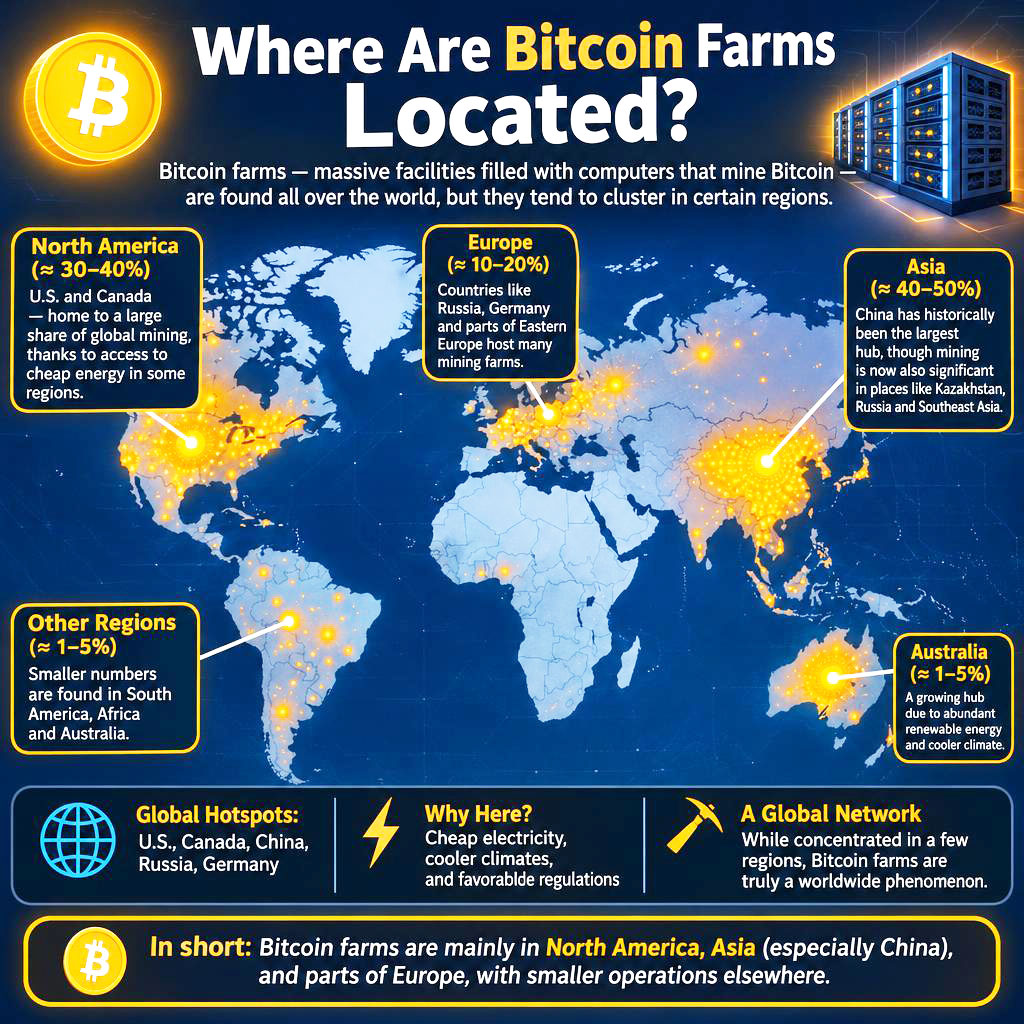 Bitcoin mining takes place in many parts of the world. Mining companies generally look for locations offering a combination of:
- Competitive electricity prices.
- Reliable power infrastructure.
- Suitable climate conditions.
- Access to industrial premises.
- Favourable regulatory conditions.
- Reliable internet connectivity.
Historically, mining activity has shifted between countries as electricity prices, regulations and economic conditions have changed. The United States (for instance, Texas), circa 37%-40% has become an important centre for industrial Bitcoin mining.
Other countries and regions have also attracted mining activity, including Canada, Russia, Kazakhstan, the United Arab Emirates, Ethiopia, Bhutan and parts of Scandinavia. However, the global distribution changes over time.
How Many Bitcoin Farms Are There in the World?
This is an interesting question, but there is no reliable, complete global register of Bitcoin mining facilities. The Bitcoin protocol does not require miners to register their physical locations. So, there is no exact official count of how many Bitcoin “farms” exist in the world, because mining operations range from massive corporate data centers to smaller private setups, and individual home.
Instead of tracking individual buildings, the global Bitcoin network is measured based on its active hardware and hashrate:
- Mining units: There are more than 4.8 million specialized ASIC mining units in operation across the network worldwide.
- Network hashrate: The total computational capacity supporting the network stands at approximately 932 EH/s (exahashes per second).
The Largest public bitcoin mining companies in 2026 has been,
Rank Company Ticker Country Market capitalisation (USD)
- IREN IREN Australia $13.84bn
- Hut 8 HUT Canada $10.55bn
- TeraWulf WULF US $8.08bn
- Riot Platforms RIOT US $7.33bn
- Cipher Digital CIFR US $6.77bn
- Core Scientific CORZ US $6.24bn
- MARA Holdings MARA US $3.69bn
- CleanSpark CLSK US $2.97bn
- Bitdeer Technologies Group BTDR Singapore $2.11bn
A mining operation can be owned by a company, operated privately or distributed across several facilities. Furthermore, some facilities are small, temporary or operated without publicly identifying their location. This makes it difficult to establish an exact global number.
You can track real-time network distribution and country-by-country statistics on the Cambridge Centre for Alternative Finance Mining Map.
Why Is It Difficult to Count Bitcoin Farms?
There are several reasons:
- Bitcoin mining is decentralised.
- Mining facilities do not all operate as registered public businesses.
- Individual operators may use multiple locations.
- Mining companies can relocate equipment.
- Some facilities operate privately.
- Mining pools do not necessarily know the legal identity of every individual participant.
Research organisations therefore generally estimate mining activity using computing power rather than counting individual farms. The Cambridge Bitcoin Mining Map, developed by the Cambridge Centre for Alternative Finance, is an important example.
Its methodology uses geographical information supplied by participating mining pools to estimate the distribution of Bitcoin hashrate across different countries. It also acknowledges that its sample represents only part of the total network and that the estimates have limitations. Source: Cambridge Centre for Alternative Finance.
The important distinction is that the number of Bitcoin farms and the amount of Bitcoin mining power in a country are two different measurements.
A country could have relatively few large facilities but account for a substantial percentage of global hashrate. Another country could have many small operations with a comparatively modest contribution to the network.
Why Do Mining Companies Choose Particular Locations?
Electricity costs are one of the most important considerations. Bitcoin mining is competitive, and electricity consumption represents a substantial operating expense. A facility with access to inexpensive electricity may have a significant advantage over another operation using the same mining hardware but paying considerably more for power.
Renewable Energy and Bitcoin Mining
Some mining operations use electricity generated from renewable sources. These may include:
- Hydroelectric power.
- Wind energy.
- Solar energy.
- Geothermal energy.
Mining companies may also use electricity that would otherwise be difficult to transport or sell. However, it is important not to assume that every mining facility uses renewable electricity. The energy mix varies considerably between countries and individual operations.
Why Is Cold Weather Sometimes an Advantage?
Mining hardware produces heat, and cooling systems require additional energy. In colder climates, external air can sometimes be used to support cooling. This can reduce cooling requirements under suitable conditions.
However, climate is only one factor. Electricity prices, grid capacity, infrastructure and regulation may be considerably more important when deciding where to establish a facility.
Are Bitcoin Farms Bad for the Environment?
 Bitcoin mining consumes electricity, and its environmental impact depends partly on how that electricity is generated. If a mining facility uses electricity produced from fossil fuels, its operations may contribute to greenhouse gas emissions.
If it uses low-carbon electricity, the associated operational emissions may be lower. However, electricity generation is not the only environmental consideration. Mining also involves:
- Manufacturing specialised hardware.
- Transporting equipment.
- Replacing outdated machines.
- Managing electronic waste.
- Constructing and maintaining facilities.
There is considerable debate about Bitcoin’s environmental impact. Supporters highlight potential uses of flexible electricity demand and the ability to operate near certain energy sources.
Critics point to energy consumption, emissions and the environmental cost of manufacturing and replacing mining hardware. A balanced assessment requires examining the actual electricity sources and operational practices of individual facilities.
Are Bitcoin Farms the Same as Bitcoin Mining Pools?
No. These are two different parts of the mining industry. A Bitcoin farm is a physical operation containing mining hardware. A mining pool is a service that coordinates the computing power of multiple miners.
A single mining farm can connect to a mining pool, while a mining pool may receive computing power from thousands of different facilities and individual operators. This distinction is important when understanding the structure of the Bitcoin mining industry.
The Future of Industrial Bitcoin Farms
Bitcoin mining is becoming increasingly professional. Larger operators are investing in more efficient hardware, improved cooling systems and better electricity management. Competition is also encouraging mining companies to reconsider their operating models.
Some are exploring flexible electricity consumption, allowing their machines to reduce or temporarily stop operations when electricity becomes expensive or the power grid experiences high demand. Others are developing facilities close to energy production infrastructure. The industry is likely to continue evolving as mining rewards decrease and operational efficiency becomes increasingly important.
Conclusion: Bitcoin Farms Are the Industrial Backbone of Mining
Bitcoin farms represent the physical infrastructure behind the digital mining industry. They house specialised machines that contribute computing power to the Bitcoin network, help validate transaction blocks and maintain the Proof of Work system. Although there is no reliable worldwide count of individual mining farms, research organisations can estimate their geographical distribution by analysing mining activity and hashrate.
The industry’s development demonstrates how Bitcoin has evolved from a small technological experiment into a substantial international infrastructure sector. Understanding how these facilities operate provides a valuable insight into the resources, economics and technology required to maintain the Bitcoin network.
Disclaimer: Bitcoin mining facilities involve significant electricity, infrastructure, hardware and regulatory risks. The profitability and environmental impact of individual operations depend on their specific circumstances.