

Welcome aboard! Not everyone is familiar with FX Trading, so this will maybe be a new adventure, at least an exciting journey.
You will shortly receive a welcome email containing a password, which you can use to log in to the member area. You are on that page now, but you have not yet received the password. We directed you here immediately after you confirmed your interest and your email address.
You will also receive our newsletter, including our in-depth features that take a closer look at renowned and successful business owners and entrepreneurs. You’ll also get plenty of bonuses! We like to over-deliver!
We will now explain about the company and the person behind it, as well as the business aspect involved. It is somewhat complex and may take some time to grasp, but please take all the time you need, and feel free to ask us about anything you don’t understand!
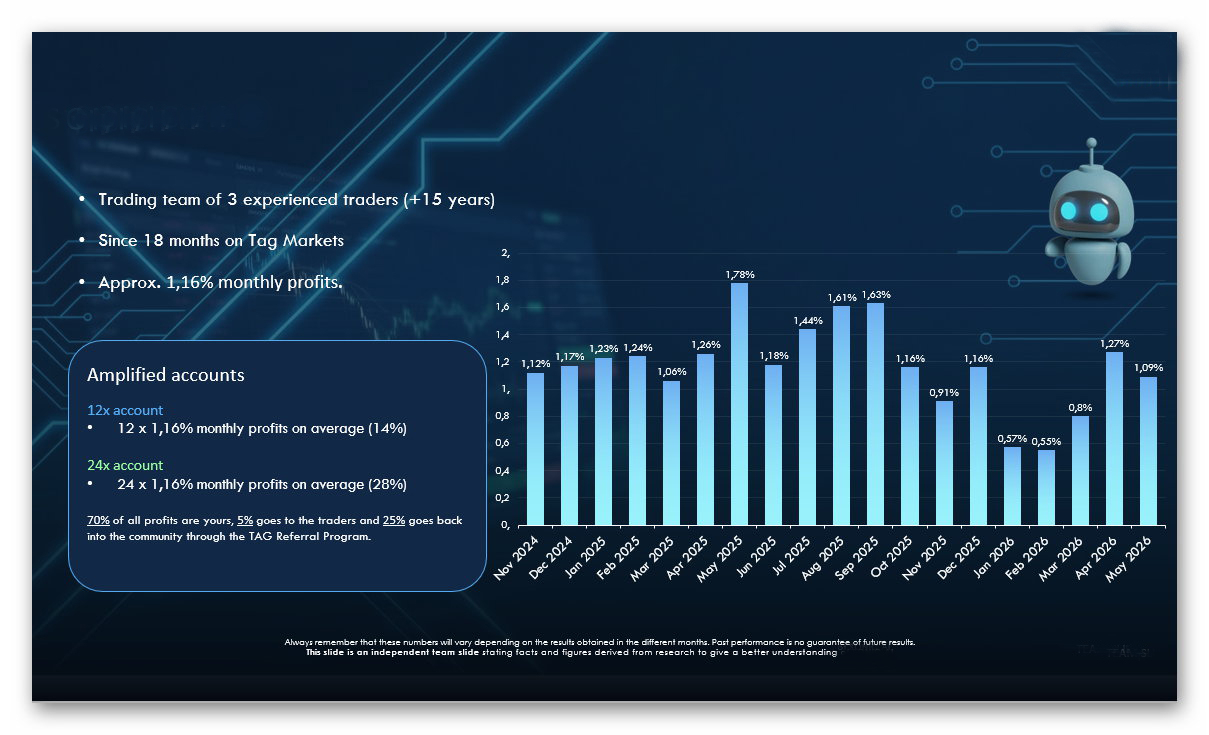
Niklas “Nik” Freihofer is the founder and CEO of Tag Market Financials Ltd. He is from Germany and trades the accounts together with two others who have many years of experience.
He entered the fields of network marketing and the brokerage industry at the age of 17, built a highly successful brokerage business, and sold it at age 23. Later, in 2023, he co-founded Tag Markets with a partner.
He is from Germany and trades the accounts together with two others who have many years of experience. Their secret is that they follow a specific strategy with complete discipline. This is something recommended by all brokers, including those that allow users to trade directly on their platforms. It is, therefore, a crucial, very crucial, element!
Beyond their skillful trading, their strategy involves, first and foremost, focusing on the gold market within the Forex space (rather than the vast and notoriously difficult-to-master currency market). Furthermore, they execute no more than a few trades per day, aiming for a daily profit level of approximately 1.2% to 1.8%.
In fact, they haven’t had a single month with a loss in all this time (see the chart below). Traders certainly incur losses, but these shouldn’t outnumber their winning trades. For example, if they were to make 8 trades in a single day, with 2 losses and 6 wins, the day would still end in a profit.
Another key aspect is strictly adhering to one’s strategy and avoiding excessive greed, even on days when things are going exceptionally well. Many people likely stumble here by letting emotions come into play.
I don’t know a great deal about Nik, but my sponsor is in close contact with him and frequently visits Dubai, where the head office is located. They maintain a very close relationship.
I want to be completely open and honest with you. Unfortunately, there is some negative information and feedback circulating about Tag Markets, coming both from private individuals and from government authorities in various countries. As for the feedback from individuals, much of it concerns customer support, which may have been neglected. Tag Markets has experienced explosive growth in just the last few months, and growing pains are inevitable in any expanding company.
There have been other, more serious concerns, specifically, reports of people being unable to withdraw their funds and accounts being locked. I’m not sure about the specifics, but Tag Markets offers a wide variety of Forex services and an even greater number of strategies. The strategy we follow, however, is performing perfectly.
Regarding the hesitation, or even discouragement, from certain countries: Tags holds a license in Mauritius and, more recently, one in South Africa (so, not “offshore”). The reviews and posts discussing this date from before that license was secured. Another license is also in the works for Malta, which would cover Europe. And naturally, things become significantly simpler in that scenario. We are Europeans and we can tell that it works for us.
As you might expect, obtaining licenses and approvals takes quite a long time. It also costs money; you can’t exactly hold a license in every single country that exists. That’s not how the law is structured, either, it stipulates that if you have a physical office in a given country, you must hold a license for that country.

Watch this video first! This video presents Tag Markets in a very simple and effective way. It provides a good insight into how it works and what it contains. The video is in Swedish, but if you turn on YouTube’s translation feature, you’ll get a presentation just as good as the original.
Anyway, the countries that raised objections regarding Tag Markets Trading’s operations were Austria in February 2026, and Quebec, Canada, in September 2026. Austria’s Financial Market Authority (FMA) stated that Tag Markets did not have authorization to conduct securities transactions in Austria that require a license. Authorities in Quebec indicated that Tag Markets was not registered with the regulatory body and lacked authorization to solicit investors in Quebec.
There is no law stating that one must hold a license in every country where one operates. The law stipulates that a license for financial services is required in any country where an entity maintains a physical presence, such as an office or a branch. However, even if not explicitly stated in law, it is entirely possible that these two jurisdictions impose stricter requirements and regulations regarding financial services. That may well be the case; for instance, such activities are strictly prohibited in the United States.
Besides, such a process is extremely costly and time-consuming. There are 195 generally recognized countries in the world.
Criticism was also raised regarding the fact that Tag is not authorized or regulated by any financial supervisory authority within the EU. With Tag’s Malta license, however, that issue should be resolved.
So, I have now addressed all the objections and warnings that have been raised against Tags. There is no definitive verdict yet. Those of us who are involved, myself, my sponsors, and many others, are, at the very least, satisfied with Tag, the investments made, and the company’s way of operating.
One thing that strikes me, however, is that people who use this type of marketing method are often accused of running a pyramid scheme (which is illegal) or a scam, regardless of whether or not that is actually the case. But no such accusations have been leveled against Tags, which is a good thing, as that is certainly not something you would want to be associated with.
Let me share a story. I knew a guy who ran a company in a profitable industry, and many people joined. However, he was unwilling to relinquish any control; he refused to hire a CEO, a marketing director, a CFO, or anyone else in a senior role. Eventually, he developed a sense of grandiosity, because he started throwing money around in every direction. The entire company collapsed.
As you can imagine, a vast sum of money was involved. In the end, he became a hunted man, and I don’t believe he is still alive today.
Let me now share a scenario: If the thought has crossed your mind that this might be a pyramid scheme or a scam, I’d like to point out a few things. First, Nik began trading at the age of 17 and is still young, around 28 years old (as of 2026). Trading is his entire life. If he were to crash the company and take all the money, he would end up being hunted just like the man in my story. Where could he possibly hide? He would never be able to trade again; if he tried, someone would surely track him down.
Contrast that with his current path: maintaining a solid reputation and earning a fortune through his trading activities (after all, the traders take their fees before distributing any returns).
Let me give you an example regarding both all the negatives and these issues. My sponsor earns a significant amount of money from this and has absolutely no trouble withdrawing their funds.
He works very closely with the management team and is frequently at the head office in Dubai. Furthermore, he has access to VIP support, meaning that should any issues arise, he receives immediate assistance, and matters are usually resolved quite quickly. We work in teams, and we all benefit from helping one another. So, if you work with me, he will also help you with things that I cannot assist with. If you are already familiar with this way of working, or if it sounds appealing, then you have come to the right place!
A lot is happening in the company. Among other things, several leadership positions have been filled, which should allow for a better distribution of workloads. So, the “growing pains” they’ve been experiencing ought to, if not disappear entirely, at least be significantly reduced. Major initiatives are also underway, and several implementations are being carried out. For instance, a proprietary card called “Bix” has recently been launched. This is a collaboration with the former Deputy CEO of American Express. With this card, you can shop just as you normally would, but there are also opportunities to earn money, including when others make purchases.
Jimmy explains the concept. He got involved in network marketing at the age of 18 and has been very active ever since. After joining Tags, he also became interested in what to do with the “extra” money generated by the investments.
Jimmy explains The Big Picture
Jimmy explains the Compensation Plan
Network Marketing – Clarity and a Deeper Look
Scam etc
Puts this information in a small box, a bit off to the side.
Let me explain a bit about what scams and similar things are, how they differ from other ventures, and how you can avoid them. First, however, I want to shed some light on legitimate business, which often faces similar kinds of criticism.
There are surely many people who would have liked to try their hand at a legitimate business but fell by the wayside. The reasons for this can be numerous; often, it stems from the fact that they have heard a great many malicious rumors.
Product-based companies, for instance, frequently use these types of marketing methods. If a company has been around for a few years, you can be confident that it is legitimate. Furthermore, it is worth noting that these companies often offer the very best products, featuring top-quality ingredients in concentrations high enough for the body to actually absorb and utilize. Many cheap alternatives, such as certain Aloe Vera or Omega-3 supplements, are essentially junk; a complete waste of money. Many of these legitimate companies also conduct their own product development and research.
So, that’s that!
It is easy to explain why such negative opinions arise. Quite simply, individuals join these companies, often having been promised far too much. While what they were told may well be true, success requires foundational work. No company in the world is going to pay you if your sales volume doesn’t grow at all. The harsh reality is that if these individuals fail to bring new people into the company, thereby generating commissions and sales, they eventually lose interest and quit; often, I suspect, far too soon.
They then proceed to condemn the company and spread negative claims (without ever explaining the underlying reasons). It’s also worth noting that they might have asked 10 people, usually those closest to them. But what about the 11th person? What if they actually liked the whole idea? You never know. A good sponsor helps newcomers with their initial contacts. Perhaps the person in question had a poor sponsor and didn’t get that kind of support, they tried to explain everything on their own (which is impossible to do at the start), and the whole thing just fell apart.
I’ve met quite a few people who were genuinely interested and really fired up! But then they went home and talked to their spouse, sibling, or close friends, who immediately tore the idea down, dumping all their prejudices and the rumors they’d heard onto them, saying things like, “You’d better stay away from that.”
As you can see, there can be many reasons why things didn’t work out, and it’s certainly not the fault of the new recruit.
Then there are those who are even worse, unlike the people who at least gave it a try. Many of the people on social media and elsewhere who dismiss these companies have no personal experience whatsoever. In other words, they don’t actually know. They aren’t in a position to comment, yet they jump on the bandwagon and repeat what they’ve heard. And just like that, the cycle begins and keeps growing.
Anyway, that covers those aspects as well.
But before I explain what scams and similar schemes are, one thing occurred to me. Regarding the bad reputation, well, if *everyone* jumped on board, what would that look like? It’s safe to say that, statistically, it would likely become overrepresented. So, in reality, it doesn’t bother me all that much.
And before we close this chapter, I want to clear a few things up regarding scams, pyramid schemes, and Ponzi schemes. First of all, consider those who criticize legitimate companies, like the ones mentioned above, by labeling them “pyramid schemes.” Let me state clearly: pyramid schemes are illegal. No company could survive if it were classified as such by, for example, government authorities. The product is what matters, not simply recruiting a large number of people who pay just to join (which, in the past, was often the primary requirement).
Scam: A scam is a dishonest scheme, a trick, or a deceptive plan designed to deceive people into giving something away, often their money. For example, many years ago there were online companies that you could “buy into”, for various reasons, and receive payment in return. These companies were set up with a single purpose: to keep running for as long as possible, paying out as little as they could (just enough to keep up appearances), and then taking all the money and shutting down. This might fall under the category of a Ponzi scheme, but I call it a scam.
Pyramid: A pyramid scheme is a fraudulent or unsustainable business arrangement in which participants are encouraged to recruit new members, and the money or rewards they receive depend primarily on bringing more people into the scheme rather than selling genuine products or services to real customers.
In other words, a pyramid scheme is a system where people at the top make money from people recruited below them, and those people must recruit even more participants to have a chance of earning money.
But every referral or network marketing business is not a scam, pyramid or ponzi scheme:
Ponzi: A Ponzi scheme is a type of financial fraud in which a person or organization pays earlier investors using money collected from newer investors, rather than from genuine profits generated by a legitimate business or investment.
In simple terms, a Ponzi scheme is a fraudulent investment arrangement that uses new investors’ money to pay existing investors, creating the illusion that the investment is profitable.
How a Ponzi scheme work:
- They promise something
Someone promises investors unusually high or consistent returns, often claiming the investment is safe or highly profitable.
- New money comes in
People invest their money, believing it will generate legitimate profits.
- Earlier investors get paid
The operator uses money from newer investors to pay the promised returns to earlier investors.
- The scheme collapses
When too few new investors join or too many people demand their money back, the operator cannot meet the promised payments.
The crucial questions are:
- Are rewards primarily generated by genuine sales to customers, or by recruiting new paying members?
- Is there real demand for the product or service apart from the opportunity to join the business?
- Must participants pay substantial fees or buy inventory to qualify for rewards?
- Are the promised earnings supported by credible evidence?
The exact legal test varies by jurisdiction. A company selling real products is not automatically legitimate if recruitment, rather than genuine retail demand, drives its compensation structure.
There is a very good site about Ponzi schemes, investment scams, or fraud, where you can get a really good insight into what they are. https://moneysmart.gov.au/financial-scams/ponzi-schemes.
Do you remember Bernard “Bernie” Madoff? The former Nasdaq chairman and founder of the Wall Street firm Bernard L. Madoff Investment Securities LLC, etc.
In 2008, the largest Ponzi scheme in history was uncovered, a scheme that had been structured as such from the very beginning (right through to the end). This is the Madoff investment scandal.
It’s an interesting, yet deeply frightening, story. You can read more about it here: https://en.wikipedia.org/wiki/Madoff_investment_scandal.
We want you to be aware of this as well, and to have sufficient knowledge about it. That is why we are posting it.
By the way, more people earn more money from their trading account than from the affiliate side of things. So, this business aspect is not of critical importance!
Real Network Marketing
decisions, should you need to. You’ve got the big picture now.
Perhaps I should go into a bit more detail regarding the payment system…
Just as I explain what a scam is, I should probably also explain what genuine network marketing is, and, above all, what it actually entails. If you haven’t been scared off by this yet, it means you’re either resilient, know better, or are simply interested enough to keep going.
Network Marketing has many names, also known as Multi-Level Marketing (MLM), Referral Marketing, Relationship Marketing, Direct Selling Marketing, och även det kanske mer kända, Affiliate Marketing. Affiliate marketing is a performance-based marketing model where individuals or businesses (affiliates) earn commissions for promoting products or services of advertisers (brands). Affiliates earn a commission when their marketing efforts result in a sale, lead, or other desired action. Affiliate marketing dates back to the 1990s, with Amazon launching one of the first programs. Since then, it has grown into a thriving industry worth circa $17 billion. It’s evolving with technology and digital marketing trends.
You could almost compare it to franchising, that’s how I see it, at least, but without the often very high costs associated with that model. You essentially become an independent partner in the business. Not bad at all: you gain the right to market and sell their products, and you get paid for doing so.
There is nothing particularly strange about this; virtually all companies use affiliate marketing in one way or another. “Refer a buyer for a car purchase and get $100”, this and similar methods are very common. However, while “affiliates” aren’t exactly being deceived, they are being exploited. They receive a one-time payout and nothing more—which amounts to little more than pocket change. That said, there is a form of affiliate business that offers far greater potential than mere “peanuts.” This exists within the Internet Marketing (IM) industry, platforms like ClickBank, JVZoo, Warrior Plus, etc., where you can earn up to 50% (or sometimes more) of a product’s price. In the IM industry, it is common to offer a product at a low price point, a version that may lack certain key features, known as a “front-end offer.” The entire business model then relies on a series of “OTOs” (One-Time Offers); these are naturally more expensive, but also more robust. This approach can generate significant earnings from just a single product, should you wish to give it a try (as an affiliate).
Okay, back to network marketing. The difference compared to other types of business ventures is astronomical: when you acquire a buyer in a network marketing company, they become *your* customer, they are linked to you, and you can work together. Everyone starts on equal footing. It is a fair system, and you get great value for your money. The company provides training, and your sponsor—along with your new team—also offers advanced training, meetings, and so on. If you manage to secure a good sponsor, it’s worth its weight in gold. This is important, crucially important! If you end up with a poor sponsor, you’ll likely have to do almost everything yourself. Be sure to pay close attention to this if you decide to sign up somewhere!
There are large, traditional companies that utilize affiliate marketing, such as Walmart, Nike, Toyota, American Express, Apple, and so on. Nike, for instance, pays a 5% commission. There are also major “affiliate networks”, like Adtraction, Tradedoubler, and CJ Affiliate, that facilitate this. Sure, if you have a blog and want to earn some extra income by displaying ads for these companies, that’s perfectly fine, but that’s where it ends. If that “Nike buyer” then goes on to recommend a pair of shoes to someone else, you receive nothing. In a network marketing company, however, you would be compensated for both, and on an ongoing basis as well. The income you make is a commission on your retail sales, but the real wealth is generated by taking a percentage of the sales made by everyone recruited beneath you.
If we look at the major advantages for companies, the reasons why they choose this method, there is one enormous benefit for network marketing companies: they eliminate several costly stages throughout the entire supply and delivery process.
And remember, as we have mentioned, a network-based company grows three times as fast as a traditional one. Here is how they compare.
Traditional companies:
- Manufacturer: The entity that produces the product. This is where it all begins for any company selling goods.
- Importer: Sometimes, an importer may also be involved.
- Wholesaler: An intermediary is needed to purchase large volumes and store significant quantities.
- Distributor: Distributors are required between the various stages of the supply chain to manage the logistics. There may also be a distributor operating at a local level.
- Retailer: Finally, we reach the end of the line, your local store, which could be an independent shop or part of a chain. Retailers add their own margins, which can sometimes, unfortunately, become quite excessive. Of course, this depends on factors such as sales volume and fixed costs.
- Advertising: This is where the truly high costs lie. These expenses are ultimately borne by the retailer, though manufacturers and wholesalers may also run advertising campaigns or support the retailer through joint promotional efforts.
- Advertising agency: Agencies are sometimes hired to develop advertising campaigns, which naturally drives the cost of the product even higher.
- Customer: And finally, the product reaches the customer.
With network marketing companies, you can eliminate all the layers between the manufacturer and the consumer, potentially as many as eight layers.
Consequently, all the money saved by removing these layers can instead be invested in the individual, who acts as a human billboard, as well as in manufacturing, product development, research, and other areas. The company is not necessarily eliminating the work. It is changing who performs it and how that work is organized.
By reducing the number of external parties involved, the company can potentially retain more of the value created by each sale. The margins simply end up being better. When fewer businesses take a share of the selling price, the company has greater flexibility in deciding how to allocate its revenue.
It can use the savings to:
- Improve its own profitability.
- Offer more competitive customer prices.
- Increase product quality.
- Invest in research and development.
- Reward distributors for genuine sales.
- Improve customer service and support.
The pricing will be more competitive. A company that has fewer distribution layers may be able to offer attractive prices without sacrificing as much of its margin. This can make its products more competitive against businesses using traditional retail channels. It leads to a stronger relationship with the customers. Traditional businesses often depend on retailers to communicate with customers. Network Marketing can create a more direct relationship.
The company can gain better insights into:
- What customers actually want.
- Which products are popular.
- What improvements are needed.
- What customers think about pricing.
- How customer satisfaction can be improved.
This information can help the company adapt faster.
Let’s use a simplified example to illustrate the difference. Imagine a product that costs $20 to manufacture.
So, an illustrative breakdown of a $100 customer purchase might look like this.
Traditional distribution model:
- Manufacturing $20
- Intermediaries and distribution $30
- Retail and marketing $30
- Company gross margin $20
- Total customer price $100
Simplified direct network distribution model of the same $100 customer purchase:
- Manufacturing $20
- Logistics and operations $10
- Network commissions $25
- Marketing, technology and support $10
- Company gross margin $35
- Total customer price $100
In this example, the company has potentially increased its gross margin from $20 to $35 per product while allocating $25 to its distribution network.
This demonstrates the central idea: rather than paying several independent businesses, the company can allocate more of its distribution budget to the people who actually introduce, sell and support its products.
These figures are hypothetical, not industry averages.
Traditional business structures often involve several layers of intermediaries, each adding costs, markups and administrative expenses before a product reaches the final customer.
We believe there is a smarter way.
By simplifying the traditional distribution chain and reducing unnecessary intermediaries, a Network Marketing company can create a more direct connection between the company, its independent distributors and its customers.
This approach can help reduce operational expenses, improve distribution efficiency and create greater flexibility in how the business allocates its resources.
Instead of spending the majority of its distribution budget on traditional retail structures, external sales organisations and expensive advertising channels, the company can invest in its own distribution network, technology, customer service and product development. This creates the possibility of a more balanced business model in which everyone has an opportunity to benefit:
The real strength lies in combining modern technology, direct customer relationships and a performance-based distribution structure.
It is not simply about cutting out the middleman. It is about creating a more efficient way of connecting products, people and opportunities.
Cutting out unnecessary intermediaries is not just about saving money. It is about deciding where the money goes instead. A company that saves money on traditional distribution but reinvests those savings in product quality, customer satisfaction, technology, support and a sustainable compensation structure can potentially create a stronger business.
However, always distinguish between genuine savings and costs that have simply been transferred elsewhere.
For a credible Network Marketing business, two things should be clear: 1. There must be real products or services offering genuine customer value; 2. Distributor compensation should be sustainable and connected to legitimate commercial activity. These principles are particularly important when explaining the difference between a legitimate Network Marketing business and an unsustainable recruitment-driven scheme.
Adding to all this, and I have likely mentioned this on other occasions, the quality offered by companies like these, for instance in the health food industry, is extremely high. In other words, products of this quality cannot be found in retail stores!
Real Network Marketing - Compensation plan, Payment systems
One of the most important things to understand about Network Marketing (NM) is how the company pays its distributors, what activities are rewarded, how commissions are calculated and whether the income can become substantial enough to support a living.
A serious Network Marketing company should have a transparent, understandable and financially sustainable compensation plan.
The fundamental principle should be: People should be rewarded for creating genuine business value, generating sales, serving customers and building productive distribution networks — not simply for recruiting new members.
There are several different compensation systems, and many companies combine multiple systems into one comprehensive payment plan.
Let’s examine how they work, what they pay for, their advantages and disadvantages, and which ones are worth considering.
- What exactly does a Network Marketing company pay for?
A professional company can reward several different types of business activity.
Activity | What the distributor is rewarded for |
Direct sales | Selling products or services to customers. |
Customer development | Introducing new customers who make genuine purchases. |
Group sales | Developing a productive team that generates sales. |
Leadership | Supporting, training and developing other distributors. |
Sales performance | Achieving specific personal or group sales targets. |
Customer retention | Maintaining satisfied customers and repeat business. |
International development | Building productive sales organisations in additional markets. |
A well-designed compensation plan should make it clear exactly what qualifies for payment, when commissions are earned and what conditions apply. It should also distinguish between commissions on actual product sales and bonuses that depend on recruitment or purchases made primarily to qualify for rewards.
- The different payment systems in Network Marketing
There are several major compensation structures. Some are very simple, while others can be quite sophisticated. Here are the main ones.
- Retail profit / Direct Sales commission
Foundation of a healthy sales model. This is the simplest compensation method.
The distributor purchases or sells a product at a certain price and earns the difference between the wholesale price and the retail price. Example:
- Wholesale price: $60
- Customer price: $100
- Distributor’s gross profit: $40
The distributor earns $40 before personal business expenses and taxes.
Advantages:
- Easy to understand
- Directly connected to actual sales
- The distributor does not need to build a team
- Can generate income from the beginning
Disadvantages:
- Income depends on personal sales volume
- Nothing else, really
- Referral or customer acquisition bonus
Reward for bringing in customers. The distributor receives a commission or fixed bonus for introducing a new customer who makes a qualifying purchase. Example:
- You introduce a customer
- The customer purchases a $200 product package
- The company pays you a 10% commission
- You receive $20
This can be attractive because customer relationships can generate recurring sales rather than requiring a completely new customer every month.
- Unilevel compensation plan
A Unilevel plan allows you to personally introduce multiple distributors directly into your first level. Each of those distributors can introduce their own people, creating additional levels.
The company pays commissions on eligible sales volume across a specified number of levels. For example:
- Level 1: 10%
- Level 2: 5%
- Level 3: 3%
- Level 4: 2%
These percentages are illustrative, not standard industry rates.
Advantages:
- Relatively easy to understand
- No strict two-leg structure
- Can reward the development of a broad organisation
- Can support long-term team development
Disadvantages:
- Some plans require substantial personal and group sales volume
- Deeper levels may be difficult to qualify for
- Binary compensation plan
The Binary plan is one of the best-known Network Marketing structures. It divides your organisation into two main legs:
- Left leg
- Right leg
You can personally introduce people into either leg, and your organisation can grow beneath them. The company generally calculates commissions based on the eligible sales volume generated by both legs. Example:
- Left leg generates $10,000 in qualifying sales volume
- Right leg generates $8,000
- The smaller leg determines the commissionable volume
- If the commission rate is 10%, the commission is $800
This assumes the plan pays 10% on matched volume and that the volume is eligible. Some binary plans carry unused volume forward, subject to rules and limits.
Advantages:
- Relatively simple organisational structure
- Encourages teamwork
- Can reward the development of two productive groups
- May offer significant leverage when both legs generate genuine sales
Disadvantages:
- Uneven legs can restrict earnings
- Commission caps may apply
- Placement and qualification rules can be complicated
- Distributors can become overly focused on balancing recruitment rather than serving customers
- Matrix compensation plan
A Matrix plan limits the number of direct positions and sometimes the number of levels. For example, a 3 × 3 matrix means:
- Three positions on the first level
- Nine positions on the second leve
- Twenty-seven positions on the third level
That gives 39 positions across those three levels. Some companies use placement systems in which new distributors are placed beneath existing members when their first level is full.
Advantages:
- Easy to visualise
- Encourages cooperation
- Can help new distributors receive support from an existing organisation
Disadvantages:
- Limited positions can restrict personal organisation development
- Placement rules can be confusing
- A filled matrix does not guarantee sales or income
There are a few others, but we won’t go into those; they can generally be considered quite rare, for example Stair-step / Breakaway compensation plan, and Hybrid compensation plan.
What constitutes reasonable compensation in network marketing? A fair compensation structure should have five important characteristics:
- Reward genuine business activity.
People should earn money because they create real value through product sales, customer relationships and productive business development
- Reward both individual effort and teamwork.
Someone who develops their own customer base should be able to earn without having to build a large organisation. Likewise, people who genuinely develop and support productive teams should have opportunities for additional compensation
- Avoid unreasonable entry costs.
Distributors should not have to purchase expensive packages or maintain unnecessary monthly purchases to remain eligible for commissions.
- Make the payment structure transparent.
Everyone should understand:
- What they are paid for
- How commissions are calculated
- What qualifications apply
- When they receive their money
- What can cause commissions to be reversed
How much can you realistically earn?
This is probably the most important question. There is no universal salary in Network Marketing. Your earnings depend on your product, customers, sales volume, commission rates, team performance, expenses and the amount of time you invest.
Let’s consider three hypothetical examples.
Example A – Part-time distributor, $300/month. Illustrative gross commission. Supplementary income:
- Personal customer sales: $150
- Team commissions: $100
- Other bonuses: $50
Example B – Established distributor, $2,000/month. Illustrative gross commission. Potential full-time income:
- Personal customer sales: $400
- Team commissions: $1,100
- Leadership bonuses: $500
Example C – Experienced business builder, $7,000/month. Illustrative gross commission. High-performing business:
- Personal customer sales: $500
- Team commissions: $4,000
- Leadership and performance bonuses: $2,500
These are mathematical examples, not typical earnings, forecasts or promises. They do not establish how likely anyone is to reach these amounts.
In general, I would evaluate a network marketing company’s compensation structure based on three factors:
- Sales: People who generate genuine customer demand should earn
- Development: People who build productive sales organisations should earn additional commissions
- Leadership: People who train, support and develop successful independent businesses should be rewarded
The best model is not necessarily the one with the most payment methods. It is the one that creates a fair relationship between the company’s revenue, the customer’s value, the distributor’s work, and the compensation received. A good compensation plan perhaps should make it possible to earn without recruiting, provide opportunities to grow through teamwork, at least reward long-term customer value.
Real Network Marketing - Bonus systems
Bonuses are one of the most interesting parts of a Network Marketing compensation plan. They are also one of the areas where companies can differentiate themselves significantly.
A serious company should have bonuses that are:
- Clearly explained
- Based on measurable performanc
- Financially sustainable
- Achievable without excessive personal spending
- Connected to genuine product sales and customer demand
- Paid according to transparent rules
There is also another important aspect that is sometimes overlooked: retail customers should have their own benefits and rewards. They should not have to become distributors to receive good prices, loyalty rewards or special offers.
Let’s look at the most common bonus systems in detail.
- Fast Start Bonus
Very common in Network Marketing. The Fast Start Bonus rewards new distributors for getting their business started successfully. It is usually available during the first 30, 60 or 90 days after joining. The purpose is to encourage new distributors to:
- Learn about the products
- Introduce their first customers
- Make their first genuine sales
- Establish a small customer base
- Introduce and support their first independent distributors
Example:
| Achievement | Bonus |
| First 3 qualifying customers | $50 |
| First 5 qualifying customers | $100 |
| First 10 qualifying customers | $250 |
These are hypothetical bonus amounts.
It’s a fair Start up plan to have this bonuses, provided the targets are realistic and based on actual customer purchases. A $50–$250 bonus for developing an initial customer base can be a reasonable incentive.
However, it becomes problematic if the distributor must purchase an expensive starter package or recruit people who have no genuine interest in the products.
- Retail Sales Bonus
One of the most important bonuses. This bonus rewards distributors for selling products directly to ordinary customers. It is particularly important because it encourages distributors to develop a real customer base rather than concentrate exclusively on recruiting.
Example of Retail Sales Bonus:
A distributor generates $5,000 in monthly retail sales. The company offers a 10% retail sales bonus.
- Monthly retail sales: $5,000
- Bonus rate: 10%
- Distributor receives: $500
Some companies pay retail profit as a separate margin, while others pay a commission on verified sales. The exact calculation depends on the company’s model.
This is one of the fairest bonus structures because it rewards measurable commercial activity. I would make this a central part of any serious compensation plan.
- Personal Volume Bonus (PV Bonus)
This bonus rewards a distributor for achieving a certain level of personal sales volume within a particular period.
PV usually refers to Personal Volume, which is a points-based or monetary measure assigned to eligible product purchases. Example:
| Monthly personal volume | Bonus |
| 100 PV | $20 |
| 250 PV | $60 |
| 500 PV | $150 |
| 1,000 PV | $350 |
These figures are illustrative.
The important question is whether PV comes from actual customer sales, genuine personal consumption or purchases made simply to qualify for bonuses. It can be fair if the targets are realistic and do not encourage distributors to buy products they do not need or cannot sell. I would prefer customer-generated volume to be the main qualification method.
- Group Volume Bonus (GV Bonus)
This is one of the most important bonuses for distributors who develop a team. The company rewards you according to the combined qualifying sales volume generated by your organisation. For example:
- Your personal team generates $20,000 in monthly qualifying sales.
- Your commission rate is 5%.
- Your group volume bonus is $1,000.
A company may calculate this using:
- Total group sales.
- Eligible sales volume.
- Specific organisational levels.
- Rank-dependent commission rates.
Potentially it’s fair, it rewards teamwork and business development.
- Matching Bonus
Leadership incentive. The Matching Bonus rewards successful distributors by giving them an additional percentage of the commissions earned by people in their organisation. This is often used to encourage leadership development. Example:
You have three qualified leaders in your organisation.
| Leader | Monthly commission | Your matching bonus |
| Leader A | $1,000 | 5% = $50 |
| Leader B | $2,000 | 5% = $100 |
| Leader C | $3,000 | 5% = $150 |
| Total | $6,000 | $300 |
You receive $300 in matching bonuses. This is not deducted from the leaders’ commissions in every compensation plan; the company may fund the additional bonus separately. It can be very fair because it rewards distributors who develop other capable business builders.
However, the qualification requirements should be reasonable. A leader should not need to maintain excessive personal purchases to receive a matching bonus.
- Leadership Bonus
Rewards long-term development. This bonus rewards people who successfully develop, train and support other leaders. It may be based on:
- The number of qualified leaders in your organisation
- Their sales performance
- The depth of your leadership structure
- The stability of your organisation
- Your own sales and leadership qualifications
Example:
| Leadership achievement | Monthly bonus |
| 2 qualified leaders | $200 |
| 4 qualified leaders | $500 |
| 6 qualified leaders | $1,000 |
| 10 qualified leaders | $2,000 |
These are illustrative figures. It’s a fair bonus if leadership is measured through genuine business performance rather than simply the number of people recruited. A particularly good approach is to reward leaders whose teams have real customers, consistent sales and good customer retention.
- Rank Advancement Bonus
Rank bonuses are not simply the seventh item in the sequence of bonuses, following, for instance, the “Fast Start Bonus” (which is the very first one). Instead, they are a constant, underlying feature. They serve as an incentive, a “carrot”, encouraging you to “climb” to each new level, which offers distinct advantages.
You are simply promoted, like a private in the military advancing to the ranks of corporal, sergeant, lieutenant, captain, and so on. Reaching a certain level, such as moving from Silver to Gold, requires a specific group volume; essentially, this means you receive higher compensation for the work you have performed. Think of this as a milestone.
Most Network Marketing companies have a rank structure. As distributors grow their business, they can qualify for higher ranks and receive one-time or recurring bonuses. For example:
| Rank | Illustrative achievement bonus |
| Bronze | $100 |
| Silver | $250 |
| Gold | $500 |
| Platinum | $1,000 |
| Diamond | $2,500 |
| Crown Diamond | $5,000 |
A rank may require a combination of:
- Personal sales
- Customer volume
- Group volume
- Qualified leadership positions
- Sales volume from different organisational legs
This is a good and fair bonus. A good system provides achievable milestones and rewards genuine growth.
A bad system makes higher ranks dependent on recruiting large numbers of people or buying products to maintain qualification.
There may also be some different approaches for more advanced leadership compensation bonuses, and Pool bonuses for the very top tier within the company.
However, one bonus that has always been popular and well-received is the Car Bonus. The company offers financial support towards a vehicle for distributors who achieve a certain rank or sales target. This is one of the most attractive incentives offered by certain network marketing companies, and, I might add, one that is not too difficult to achieve. For example:
- Bronze: $200 monthly vehicle allowance.
- Silver: $400.
- Gold: $600.
- Diamond: $1,000.
Some companies offer a fixed monthly allowance, while others reimburse qualifying vehicle expenses or lease payments.
It is a good recognition reward, but you must look carefully at the conditions. Is the allowance guaranteed? Must you maintain a certain rank every month? Do you have to lease or finance the vehicle yourself? What happens if you lose qualification?
A car incentive should never be presented as a completely free car if the distributor has to finance most of the cost.
There is a similar system for Pension schemes, less common, perhaps, but I have encountered it. In this arrangement, the company contributes a specific sum of money each month into a pension fund. Of course, if you have reached this level, you could just as easily set that up yourself…
There may also be Travel and Holiday Bonus, Customer Retention Bonus Contest, and Seasonal Bonuses, etc. As you can see, the network marketing industry often offers quite generous bonuses. And there is more, see below…
Let’s imagine that you are seeing this for the first time and taking the time to understand the compensation plan. Wouldn’t this be something worth striving for? The fact is, and don’t forget this, you do the foundational work, and then things gain momentum. This happens partly because you become more skilled at explaining, inspiring, looking after, and nurturing “your people.” It’s also true that, in the beginning, you work alone, though with professional support. Once you have built up a business like this, others are working to develop their own operations, which in turn benefits you as well!
What happens if you manage to reach levels like these? A study was conducted many years ago, in Scandinavia or elsewhere in Europe, asking how much extra income per month the average person would need to get by reasonably well. It turned out that most people could live quite comfortably with an additional $500 or so per month. Today, the figure is likely somewhat higher, due to various wars, inflation, and other rising costs.
Furthermore, companies often offer special promotions for individual products—for instance, in connection with major holidays, Easter, Christmas, Black Friday, Mother’s Day, Father’s Day, and so on. There may also be introductory prices for new products or special product bundles.
Many of these offers can also be directed toward the end consumer, who may learn about them via the company’s website or directly from a distributor, who, naturally, takes great care of their customers.
Real Network Marketing - Conclusion
My conclusion is, I would join a network marketing compnay because I find the potential and the income opportunities to be a strong and compelling incentive. I would also like to participate to help others, and because it offers the chance to meet many new, potential friends. Furthermore, I would join simply because I find it enjoyable.
To draw a conclusion regarding the factual side of this, Let us ask the source directly, probably the best. There are plenty of studies and surveys that can provide answers, for instance, regarding what constitutes a reasonable amount of extra income or what people would do if they didn’t have to worry about paying their bills every month.
For example, research into the question “What would be a reasonable extra monthly income?”, conducted by institutions such as the Stockholm School of Economics, helps estimate roughly how much additional income might be needed, and what it would be used for.
Possible additional monthly income, after tax converted into US dollars. illustrative targets, not survey findings:
| $100–$200 | A little extra | Helps with smaller bills, groceries or subscriptions. |
| $300–$500 | Noticeable improvement | More room for savings, family activities and unexpected expenses. |
| $500–$800 | A meaningful supplement | Can make everyday life considerably more comfortable. |
| $1,000–$1,500 | A substantial supplement | Can change the household’s financial situation and create greater freedom. |
| $2,000+ | Major additional income | |
Another study examined “the demand for additional income.” This was a Swedish survey conducted in March 2026, involving 1,000 people aged 18–80, which found that:
- 61% would consider taking an extra job to strengthen their finances
- 23% had needed an extra job at some point during the previous five years to make ends meet
- Among those with the lowest incomes, more than half had needed extra work.
This suggests that additional income is a genuine concern for a significant portion of the population.
Personally, I would lean toward the findings of a study conducted many years ago, which suggested that an extra $500 per month would be reasonable. Accounting for inflation and index-based adjustments, this would translate to a range of $500–$800. Alternatively, a figure in the $300–$500/$600 range could serve as a starting point.
Why?
- It is meaningful without necessarily requiring someone to leave their regular employment
- It can help reduce financial pressure
- It can create room for savings and unexpected expenses
- It can provide opportunities for holidays, hobbies and family activities
- It may help people feel less dependent on a single source of income
Several European and international studies have also been conducted, examining what people value most when financial pressure is reduced—for instance, what they would do with more freedom, what gives life meaning, and what they would prioritize if they no longer had to worry about paying their monthly bills.
| Life priority | Percentage considering it important |
| Health | 99% |
| Family | 97% |
| Friends and acquaintances | 95% |
| Leisure time | 90% |
| Work | 84% |
| Helping others / voluntary work | 79% |
This is a useful indication that people’s priorities extend well beyond earning money.
Another European study, published in 2023 and based on the European Values Study and World Values Survey, examined the importance of family, leisure, work and friends across 46 countries. Family was most frequently considered important, followed by work, friends and leisure. The importance of family, friends and leisure had increased over the period examined.
What would people want to change if money were no longer a constant worry? The studies do not ask that exact hypothetical question, but their findings point to several recurring priorities.
- More time with family and loved ones
Being present for children, partners, and parents, without constantly worrying about work and finances - Travel and experiences
Exploring the world, discovering new cultures, and creating memories - Freedom and less stress
Having control over one’s time, being able to slow down, and enjoying everyday life - Education and personal development
Learning new skills, pursuing interests, and developing new opportunities - Helping others
Supporting family, friends, charities, and people in need of a helping hand - A better quality of life
A comfortable home, financial security, hobbies, good health, and the ability to enjoy life without constantly calculating every expense. These are reasonable interpretations of the research, rather than specific percentages derived from a single survey.
An important distinction: people do not necessarily dream of becoming rich. Many simply want more control over their time, less stress, better relationships, meaningful experiences, and the freedom to make their own decisions.
However, it is important to distinguish between how much extra income people might *want* and what they actually *need* to improve their financial situation and lead a comfortable life.
It also shows that there is financial pressure behind these wishes. Eurofound’s 2025 survey involved 27,200 respondents across the EU’s 27 member states, a bit daunting, perhaps, but hardly surprising.
Some particularly striking findings:
- 61% of respondents in low-income households struggled to make ends meet
- Only 9% of respondents in high-income households reported the same difficulty
- Around half of respondents wanted to work from home several times a week
- Mental well-being remained a significant concern, with 57% at risk of depression according to the WHO-5 screening measure
These findings illustrate how financial pressure and a lack of flexibility can affect people’s quality of life. The European Commission’s 2024 survey also found that 48% considered the high cost of living a major national priority, while 35% identified low wages.
On a more positive note, most people are not necessarily looking for a luxurious lifestyle. They are looking for the freedom to live a little more. An important distinction: people do not necessarily dream of becoming rich. Many want more control over their time, less stress, better relationships, meaningful experiences, and the freedom to make their own decisions.
Two out of three Swedes are open to taking an extra job, and nearly one in four has already needed one to make ends meet. Swedes are prepared to work more to manage their finances.
A new survey from the Sambla Group shows that two out of three Swedes would consider taking an extra job to bolster their finances, while nearly one in four has already needed an extra job over the past five years to make ends meet.
A question asked was: “Have you, at any point during the last 5 years, needed an extra job to make ends meet?”
- The survey by Sambla reveals that:
61% would consider taking an extra job to strengthen their finances; - 36% answered “yes,”
- 25% answered “maybe”
- 33% answered “no”
- 6% stated that they currently hold an extra job
The survey also shows that 23% answered “yes” when asked if they had needed an extra job at any point in the last five years to make ends meet. 77% answered “no.”
“It is striking that nearly one in four people report having already been forced to take an extra job to manage their finances. This speaks volumes about the financial pressure many households are under, even those with a regular income,” says Marcus Karlsson, a personal finance expert at Sambla.
Unsurprisingly, extra jobs are more common among those with lower incomes. According to the survey, such additional employment occurs more frequently within lower-income groups.
- Among the group reporting an annual household income of less than $10,000, approximately 57% state that they have held an extra job over the past five years to make ends meet
- In the income bracket of $10,000–$30,000, the corresponding figure is approximately 38%
- while among those reporting an income of 30,001–50,000 kronor, the figure is around 24%. (The figures are converted to US dollars.)
The survey reveals only minor differences between men and women. Regarding the willingness to take on an extra job, approximately 38% of men answered “yes,” compared to about 33% of women.
A survey conducted by Syno on behalf of the Sambla Group also highlighted these same needs and potential solutions. A total of 1,000 individuals aged 18–80 in Sweden were surveyed between March 19 and 25, 2026. The sample is nationally representative in terms of gender, age, and region.
The questions that formed the basis for this press release are: “Would you consider taking an extra job to improve your financial situation?”
- Yes: 36%
- Maybe: 25%
- No: 33%
- I already have an extra job: 6%
“Have you, at any point during the last 5 years, needed an extra job to make ends meet?”
- Yes: 23%
- No: 77%,
These responses, stemming from questions about whether people want, are open to, or actually need an extra job, are not exactly surprising, yet the figures are alarmingly high, especially when you include responses like “maybe” (which likely means “yes,” provided they find a good opportunity).
This simply reflects the current state of the world. This is how things look, and very little is being done to improve the situation. The vulnerable and the poor are being pushed out, with increasing severity, while the already wealthy grow even richer. The 80/20 rule applies here, too. Are you familiar with it? It is also known as the Pareto Principle. Essentially, it posits that 20% of the global population owns 80% of the world’s total capital. Here is what the global distribution of income and wealth looked like in 2025, and, in fact, the reality is even starker:
Population group Share of wealth Share of income
| Population group | Share of wealth | Share of income |
| Richest, 10% | 75% | 53% |
| Middle, 40% | 23% | 38% |
| Poorest, 50% | 2% | 8% |
| Source: World Inequality Report 2026. Figures are global estimates, not figures for individual countries. | ||
These figures are striking. The richest 10% own roughly three-quarters of the world’s wealth, while the poorest 50% own just 2%.
This means that, when it comes to wealth, the concentration is actually more extreme than the traditional 80/20 principle.
The same report estimates:
– The richest 1% receive approximately 20% of global income.
– The richest 1% own approximately 37% of global wealth.
– The poorest 50% own only 2% of global wealth.
Why did I think of the 80/20 rule? Well, because it fits so much in the world; it doesn’t really matter what it is. Why does the 80/20 principle remain so relevant?
There are several structural reasons:
1. Ownership creates opportunities
People who own businesses, shares, property and other productive assets can benefit from appreciation, dividends, rent and profits.
2. Capital can generate more capital
Investment returns can be reinvested, allowing wealth to compound over time.
3. Access to opportunities is unequal
Education, capital, networks, business opportunities and access to financial markets are not equally distributed.
4. Technology and globalization can concentrate rewards
Some businesses can reach millions of customers without increasing their workforce proportionally. This can produce enormous returns for successful companies and their owners.
5. Wealth and employment income work differently
Someone who depends entirely on a monthly salary generally has a different opportunity to accumulate wealth from someone who owns productive assets.
What does this mean for ordinary people, businessmen and entrepreneurs? This is where I think the 80/20 principle becomes particularly interesting.
If we look at the modern economy, there are two different ways of participating:
| Traditional approach | Ownership and entrepreneurship approach |
| Exchange time for money | Build or own productive assets |
| Depend primarily on salary | Develop several income sources |
| Limited control over working hours | Potentially greater flexibility |
| Income often stops when work stops | Some assets may generate recurring income |
| Financial progress depends heavily on employment | Financial progress can also depend on ownership and investment |
Neither approach guarantees financial success. Entrepreneurship and investing involve risk, and many businesses fail. But ownership can create opportunities that salary income alone may not provide.
The bigger question: is the world creating equal opportunities? I think this is perhaps the most interesting conclusion. The global economy is producing enormous amounts of wealth, innovation and technological progress. Yet the benefits are not distributed equally.
This raises an important question: How can ordinary people gain better access to the opportunities created by the modern economy, rather than simply remaining dependent on their monthly salary?
Education, entrepreneurship, digital business, financial literacy, investing and responsible additional-income opportunities can all be part of the discussion.
My view is that the 80/20 principle is useful not because everyone should aim to become part of the richest 20%, but because it encourages people to understand where value is created, how wealth accumulates and how they can participate more actively in the economy.
Network Marketing Federations, Independent Organisations and Business Protection, etc.
When discussing a serious Network Marketing (MLM) company, there is another important part of the industry that deserves attention: the organisations, federations, associations and independent regulatory bodies that help establish standards, promote ethical business practices and protect consumers and distributors.
These organisations are important because Network Marketing operates through relationships between companies, independent distributors, customers and international business networks. Without proper standards, transparency and accountability, the industry can become vulnerable to misleading income promises, questionable recruitment practices, poor product claims and fraudulent business models.
The purpose of industry organisations is to help create a professional, transparent, trustworthy and responsible direct-selling environment.
Let’s look at who these organisations are, what they do, how they protect the industry and what a serious MLM company should know about them.
What are MLM federations and associations?
They are organisations that represent, support or oversee aspects of the direct-selling industry.
They can operate internationally, regionally or nationally. Their responsibilities vary, but common objectives include:
- Promoting ethical business practices.
- Establishing industry standards and codes of conduct.
- Protecting consumers and independent distributors.
- Encouraging responsible business development.
- Providing education and professional training.
- Representing the industry to governments and regulators.
- Addressing complaints and ethical concerns.
- Helping distinguish legitimate direct selling from illegal pyramid schemes.
- Promoting transparency and public confidence.
It is important to understand that not all these organisations have the same legal authority. Some are trade associations. Some administer voluntary codes of ethics. Others provide independent monitoring or dispute-resolution services. Government authorities, meanwhile, have statutory enforcement powers.
The most important international organisations
Here are some of the established organisations worth knowing.
- World Federation of Direct Selling Associations (WFDSA)
International industry federation
One of the most important global organisations representing the direct-selling industry. Its mission includes promoting responsible direct selling, ethical standards and consumer protection internationally. It develops a Global Code of Ethics and supports national Direct Selling Associations.
Website: WFDSA – Ethics and Code of Conduct.
- Direct Selling Association (DSA) – USA
National trade association
Represents companies involved in direct selling in the United States. Its work includes:
- Industry representation.
- Ethical standards.
- Consumer protection.
- Business education.
- Cooperation with policymakers.
Member companies commit to its Code of Ethics.
Website: US Direct Selling Association.
- Direct Selling Europe (DSE). European industry association
Works to promote responsible direct selling across Europe. Its Code of Ethics addresses relationships between companies, independent sellers and consumers. It promotes trust, integrity and standards that meet or exceed applicable legal requirements.
Website: Direct Selling Europe – Code of Ethics.
- Direct Selling Association UK
Represents the direct-selling industry in the United Kingdom. Its responsibilities include ethical standards, consumer protection and support for responsible direct sellers. Its Code of Conduct is administered through an independent code regulator.
Website: UK Direct Selling Association – Codes.
- Direct Selling Self-Regulatory Council (DSSRC)
Independent monitoring. An important US self-regulatory programme administered by BBB National Programs. It monitors direct-selling companies and their salesforces, particularly concerning:
- Income representations.
- Product performance claims.
- Lifestyle and earnings claims.
- Advertising practices.
It can investigate concerns and seek corrective action.
Website: DSSRC – Independent oversight.
These organisations have different membership and jurisdictional arrangements. Membership in one does not automatically mean membership in another.
What do these organizations actually do?
Their work can be divided into eight major areas.
A. Establishing ethical standards
One of their most important responsibilities is creating codes of conduct. These codes establish expectations for how companies and distributors should behave. They commonly address:
- Honest product descriptions.
- Truthful income representations.
- Fair recruitment practices.
- Transparent compensation plans.
- Appropriate sales methods.
- Respect for customers.
- Refund and cancellation procedures.
- Responsible inventory management.
- Professional behaviour.
The WFDSA Global Code of Ethics, updated in September 2025, is an important international reference. National associations adopt and administer their own codes within their respective frameworks.
B. Protecting customers
Customers need protection against misleading claims, aggressive selling and unfair business practices. Associations and independent oversight organisations can promote:
- Clear product information.
- Transparent pricing.
- Refund and return procedures.
- Proper complaint handling.
- Protection of personal information.
- Honest advertising.
- Respect for consumer rights.
C. Protecting independent distributors
Distributors also need protection. For example, a responsible company should provide:
- Clear contractual agreements.
- Transparent commission calculations.
- Reliable commission payments.
- Reasonable entry costs.
- Fair termination procedures.
- Clear inventory repurchase policies.
- Training and marketing guidelines.
- A way to report unethical behaviour.
The US DSA Code of Ethics, for example, includes inventory repurchase standards and requirements concerning reasonable entry costs and accurate earnings information.
D. Preventing pyramid schemes and fraudulent operations
This is particularly important. A legitimate Network Marketing business should be based on real products or services and genuine customer demand. A pyramid scheme, by contrast, relies primarily on payments from new participants to reward earlier participants.
An organisation can help educate the industry about the difference, investigate complaints within its mandate and refer concerns to appropriate authorities. However, associations do not replace government enforcement.
E. Independent monitoring and investigations
Some organisations offer independent monitoring of company behaviour and distributor marketing.
For example, the DSSRC monitors product and income representations and provides a process for reviewing potentially misleading claims.
Website: Direct Selling Self-Regulatory Council (DSSRC)
F. Education and professional development
Associations can organise:
- Industry conferences.
- Leadership seminars.
- Compliance training.
- Ethics courses.
- Product marketing education.
- Legal and regulatory updates.
- Management workshops.
This helps companies and distributors understand their responsibilities.
G. Representing the industry
Associations also communicate with governments, policymakers, consumer organisations and the media. Their objective is to help establish clear, appropriate rules for the direct-selling industry and represent responsible companies.
H. Promoting public confidence
Perhaps their most important long-term mission is to help build confidence in an industry that has sometimes suffered from misleading marketing, unrealistic income promises and fraudulent schemes.
A trustworthy industry needs more than good products. It needs responsible companies, informed distributors, protected customers and transparent business practices.
What security and protection should a serious MLM company provide?
I would divide this into seven important areas.
- Legal and regulatory protection
- Properly registered company.
- Clear contractual agreements.
- Compliance with local laws.
- Transparent compensation arrangements.
- Appropriate consumer protection.
- Financial security
- Secure payment processing.
- Accurate accounting.
- Reliable commission payments.
- Independent financial audits where appropriate.
- Clear refund and chargeback procedures.
- Data protection
- GDPR-compliant customer data handling.
- Secure storage of personal information.
- Controlled access to accounts.
- Clear privacy policies.
- Protection against unauthorised data access.
- Digital and platform security
- Secure distributor accounts.
- Two-factor authentication.
- Encrypted communications.
- Fraud detection.
- Secure commission and payment systems.
- Fair distributor protection
- Clear distributor agreements.
- Fair termination procedures.
- Protection against misleading recruitment.
- Transparent bonus qualification.
- Proper complaint procedures.
- Product protection
- Verified product quality.
- Proper certifications where required.
- Product traceability.
- Clear warranty and return conditions.
- Evidence supporting product claims.
- Customer and distributor support
- Accessible customer service.
- Independent complaint escalation.
- Clear communication channels.
- Fraud and scam reporting.
- Ongoing education and training.
An important distinction: a company should not simply claim that it is secure. It should be able to demonstrate its security arrangements, policies, controls and independent verification.
What should an MLM company do to become recognised as professional and trustworthy?
The following steps are a recommendation:
| Step | Recommended action |
| 1 | Establish a properly registered legal company. |
| 2 | Develop a comprehensive Code of Ethics. |
| 3 | Publish transparent distributor agreements. |
| 4 | Establish independent complaint procedures. |
| 5 | Introduce GDPR and information-security policies. |
| 6 | Have the financial structure independently reviewed. |
| 7 | Provide transparent income and compensation disclosures. |
| 8 | Apply for membership in relevant national or international associations. |
| 9 | Provide ongoing ethics and compliance training. |
| 10 | Review policies and regulatory requirements regularly. |
Membership in an organization is not a requirement, but it does enhance one’s reputation. Membership is generally voluntary, depending on the specific organization.
However, it can provide several advantages:
- Greater industry recognition
- Access to professional networks
- Education and regulatory updates
- Opportunities to demonstrate commitment to ethical standards
- Access to certain complaint-resolution mechanisms
- Better dialogue with policymakers.
It is important to check whether a company is an actual member, whether membership is current and what standards the membership requires. Membership should be treated as one credibility indicator, not as a guarantee of legal compliance or financial stability.
The Six Pillars of Industry Integrity
- Protection
- Protect customers, distributors and legitimate businesses.
- Integrity
- Promote fair conduct, accountability and ethical business.
- Education
- Improve knowledge, professional skills and compliance.
- Transparency
- Encourage honest communication and clear business practices.
- Cooperation
- Connect companies, associations and authorities internationally.
- Development
- Support responsible innovation and sustainable growth.
If you would like to work with this,
there are some advantages in the industry today
Please note, it is not a requirement
Work From Home
General in 2026
- The Work-From-Home and hybrid work sector is a massive, permanent fixture of the global economy, involving hundreds of millions of workers
- Total Remote & Hybrid Workforce is approximately 330 million people worldwide work from home either partially or fully
- Adoption is highest in, for instance, about 22% of the European workforce and 26% of U.S. full-time employees work fully remotely, with an additional 52% working hybrid schedules
- Companies save an estimated $11,000 per year for each half-time remote worker due to reduced real estate, office overhead, and turnover costs
- Workers save between $2,000 and $7,000 per year on commuting, meals, and work attire, while saving an average of 72 minutes a day on transit
- Remote-first and digital-capable remote jobs continue to expand, with projections showing a 25% increase in high-income remote roles leading up to 2030
- Leading sectors are technology, software development, marketing, finance, insurance, and law are at the forefront when it comes to remote and hybrid work
- Several studies find little loss in productivity from remote work. A BLS analysis across industries reported that sectors with larger increases in remote work tended to see higher total-factor productivity growth (2019)
- Surveys also suggest many teams maintain or even boost output when hybrid/remote. One U.S. survey found 62% of managers said their hybrid/remote teams were more productive than in-office teams
- According to Business Insider, job postings for fully remote positions attract a very large share of the total number of applications, a share that has also increased over the past year.
- More people are exploring self-employment and side businesses
- More people are also reliant on additional income
- Direct selling offers a business model with low investment and flexible working hours
- Social media platforms such as Instagram, Facebook, X, WhatsApp, etc., have made it easier for sellers to reach customers
- e-Commerce integration enables direct sellers to manage orders, payments, and deliveries online
- Many Direct-Selling companies are launching mobile apps to help salespeople track sales and earnings
- Consumers are becoming more aware of genuine direct selling versus fraudulent pyramid schemes
- Regulatory rules, such as the consumer protection regulations (direct sales) from 2021, have made the industry more transparent
- More testimonials, product reviews, and collaborations with influencers increase trust in direct-selling brands
- Better communication from anywhere. Video meetings, messaging platforms, and shared workspaces make it easier to communicate with customers and colleagues
- AI tools can help people write emails, research topics, translate languages, prepare marketing materials, brainstorm ideas, and organize information.
- Lower barriers to starting an online business. Many entrepreneurs can begin with a computer, an internet connection, and affordable online services
- A more accessible starting point for many people. Remote opportunities can help people in rural areas, people who cannot easily commute, and those seeking greater flexibility access certain types of work
From the First Step to the Next Horizon
FX dynamite
Inspired by our work?
Signup! Together, we will build your ideal space


Premium Supplies
High-quality products and resources. Carefully selected premium solutions. Quality you can trust. Everything you need to succeed!
Up-to-Date Trends
Stay ahead of the latest trends. Discover new tools and opportunities. Fresh ideas for a changing market. Always evolving with the digital world.