
1. Understanding Bitcoin Mining
2. How Bitcoin Mining Works
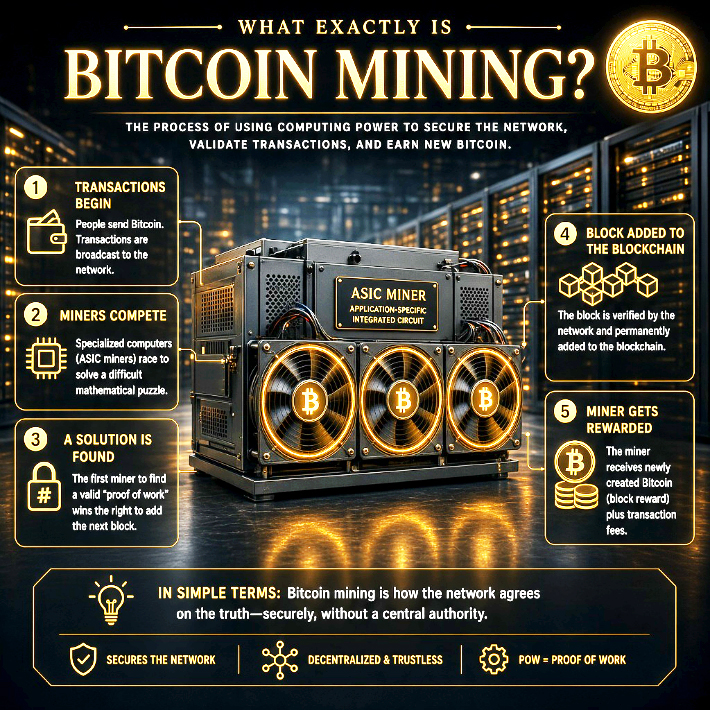 Bitcoin mining is the process of using specialized computers to compete to add new blocks of transactions to the Bitcoin blockchain. Miners help secure the network, verify transactions, and maintain its decentralized system. In return, a successful miner receives newly issued bitcoins and transaction fees.
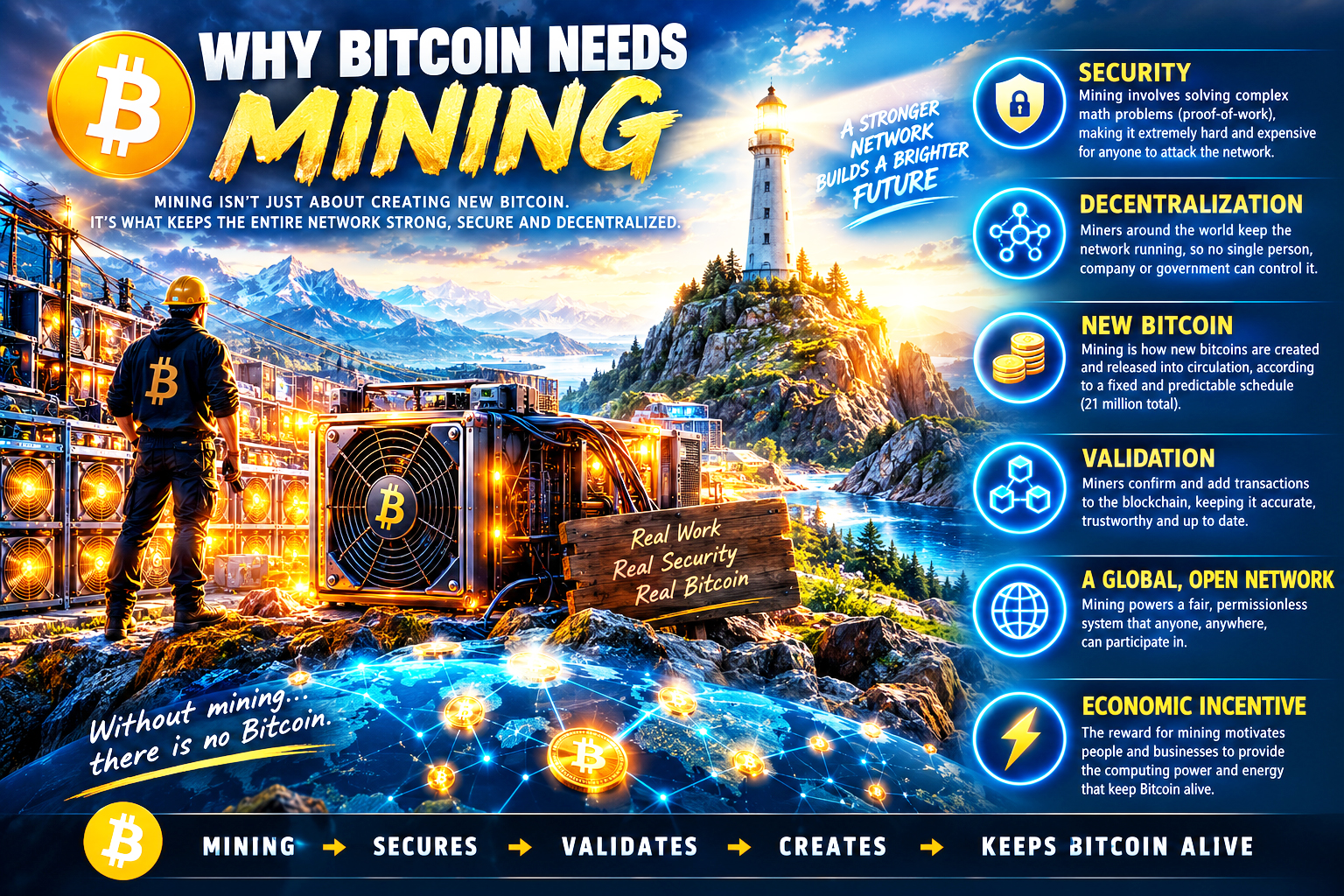 Mining helps Bitcoin agree on which transactions are valid and in what order they occur. It makes it computationally expensive to rewrite transaction history and helps prevent the same bitcoin from being spent twice.
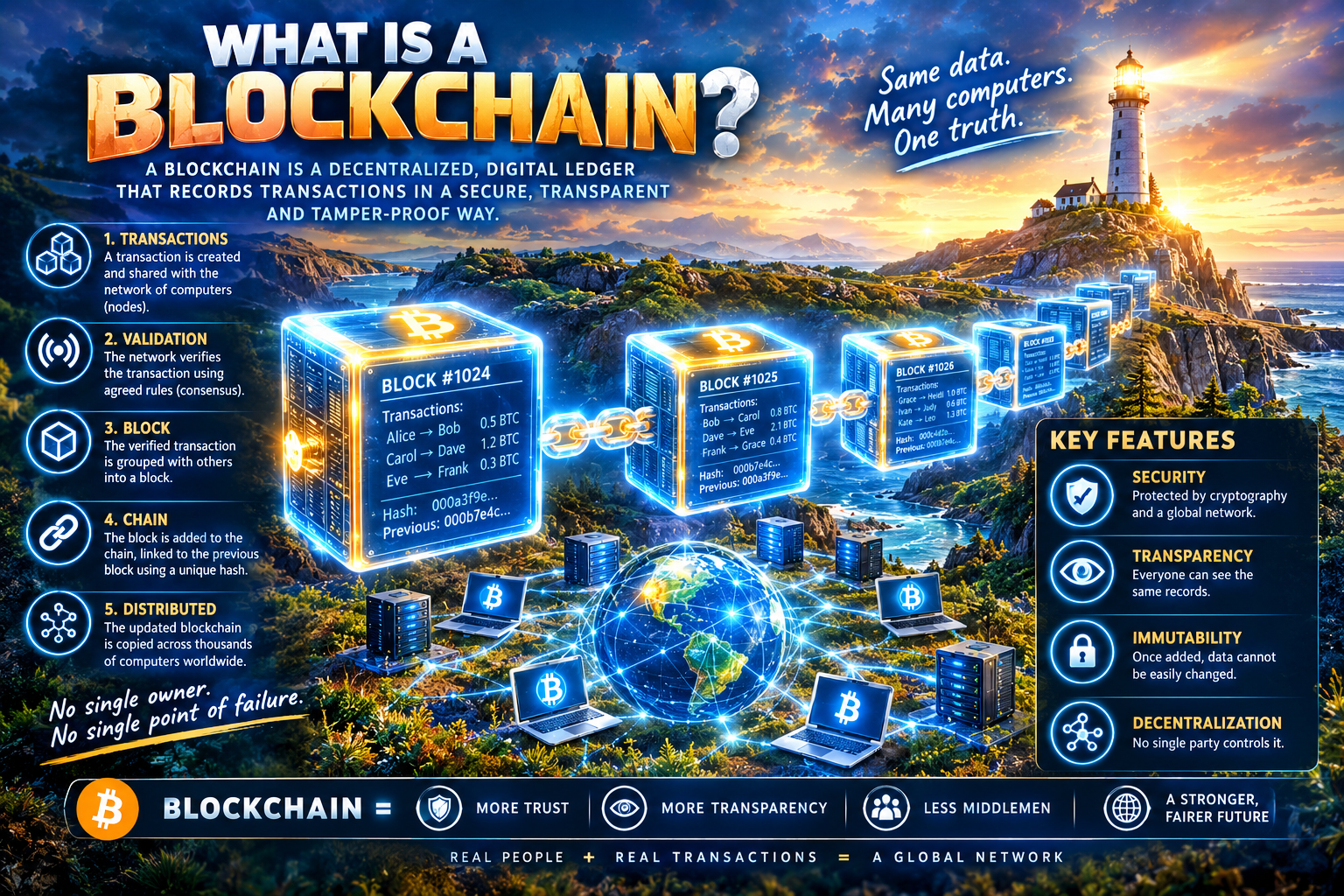 The blockchain is Bitcoin’s shared public transaction ledger. Transactions are grouped into blocks, and each accepted block links to the previous one, creating a chronological chain.
 Mining machines repeatedly calculate hashes to search for a result that meets Bitcoin’s current difficulty target. Miners also assemble candidate blocks containing valid transactions. The first miner to find a qualifying result and successfully publish an accepted block can earn the block reward and transaction fees.
 A hash is the output of a mathematical function applied to data. Bitcoin uses the SHA-256 hashing algorithm in its proof-of-work process. A small change in the input produces a different hash, so miners must perform enormous numbers of calculations to find a qualifying result.
 No. Bitcoin’s issuance rules are built into its protocol. Mining provides a way to distribute new bitcoins according to those rules while securing the network. Miners must invest in equipment and electricity, and their income is not guaranteed.
 No single company or government controls the entire Bitcoin network. Independent miners compete to produce blocks, while network participants run software that checks whether blocks and transactions follow Bitcoin’s rules.
The machine performs repeated SHA-256 calculations, testing different block-header values in search of a hash below the required target. It can perform trillions of calculations per second, depending on its model.
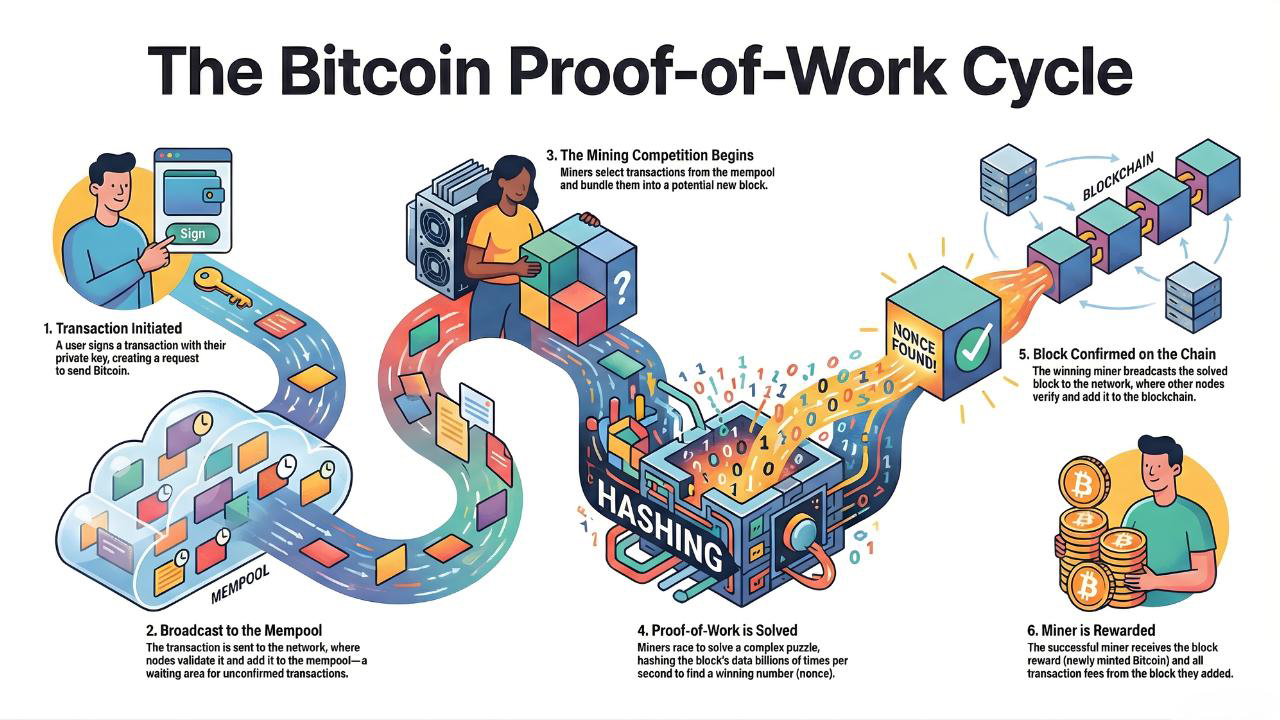
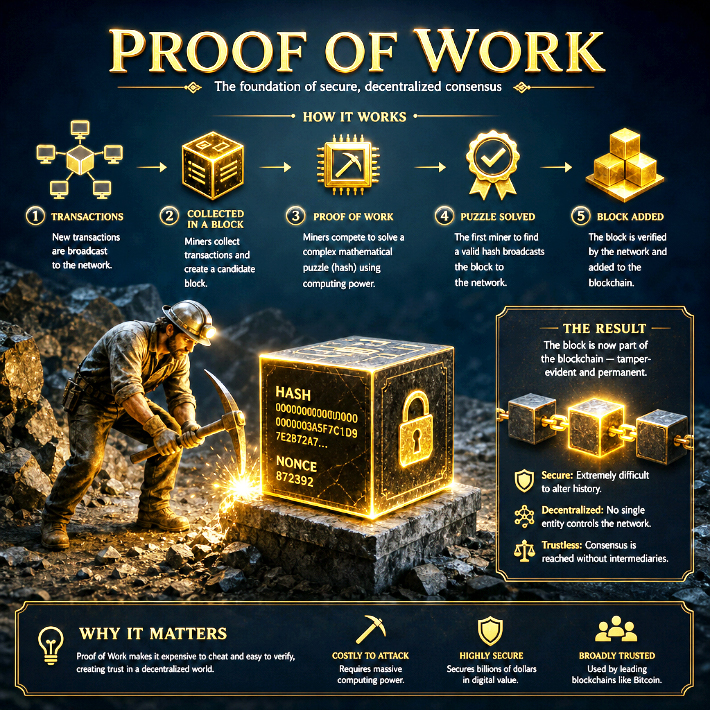 Proof of work is the system that requires miners to demonstrate that they have performed computational work. Other network participants can verify a valid result quickly, even though finding it may have required many calculations.
 The miner broadcasts the block to the network. Other nodes check its validity. If accepted, the block becomes part of the blockchain, and the miner can receive the block subsidy and applicable transaction fees through the rules governing the block reward.
 Bitcoin’s protocol adjusts mining difficulty to target an average block interval of approximately 10 minutes. Actual intervals vary: several blocks can arrive close together, or a longer period can pass without a new block.
 Mining difficulty reflects how hard it is to find a qualifying block hash. Bitcoin adjusts difficulty approximately every 2,016 blocks to keep the average block interval near 10 minutes over time.
 It consists of the block subsidy (newly issued bitcoin) plus transaction fees. Since the April 2024 halving, the subsidy has been 3.125 BTC per block. The subsidy halves approximately every 210,000 blocks, so it will change again in a future halving.
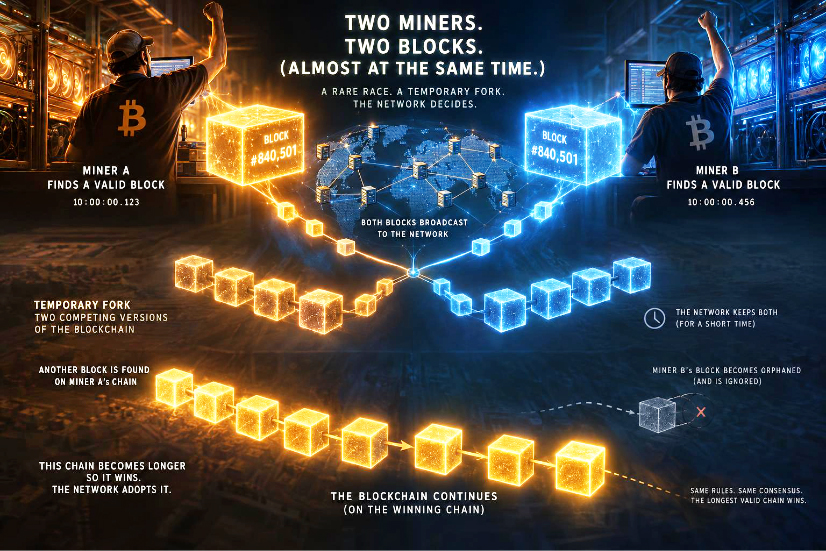 Yes. Occasionally, competing blocks appear at nearly the same time. The network temporarily follows competing branches until additional proof of work resolves the situation. A block that does not remain on the accepted chain generally does not earn a lasting reward.
3. Equipment and Getting Started
4. Solo Mining vs. Pool Mining
 Yes, if you have suitable equipment, adequate electrical capacity, cooling, ventilation, and a place where noise will not cause problems. However, residential electricity prices and heat output can make home mining financially challenging.
 Technically, you can run mining software on a regular computer, but a CPU or graphics card is generally not competitive for Bitcoin mining today. Specialized ASIC machines are used because they are far more efficient at Bitcoin’s hashing algorithm.
 Usually, you need:
- A Bitcoin ASIC miner
- A suitable power supply and electrical connection
- Reliable internet acces
- Cooling and ventilation
- A Bitcoin wallet for receiving payout
- Mining software or pool configuration
- A way to monitor electricity use, machine temperature, uptime, and earnings
 ASIC stands for Application-Specific Integrated Circuit. It is a very poserfule hardware designed for a particular task. Bitcoin ASIC miners are built specifically to perform the hashing calculations used by Bitcoin’s proof-of-work system.
 Many ASIC machines use high-speed fans and can be very loud, often unsuitable for bedrooms or ordinary living spaces. Noise-reduction enclosures can help, but they must preserve adequate cooling and may add cost.
 It depends on the machine’s power rating. For example, a miner drawing 3,500 watts continuously uses about 84 kWh per day, or 2,520 kWh over 30 days.
At an electricity price of €0.15 per kWh, that would cost about €12.60 per day or €378 over 30 days, before other expenses.
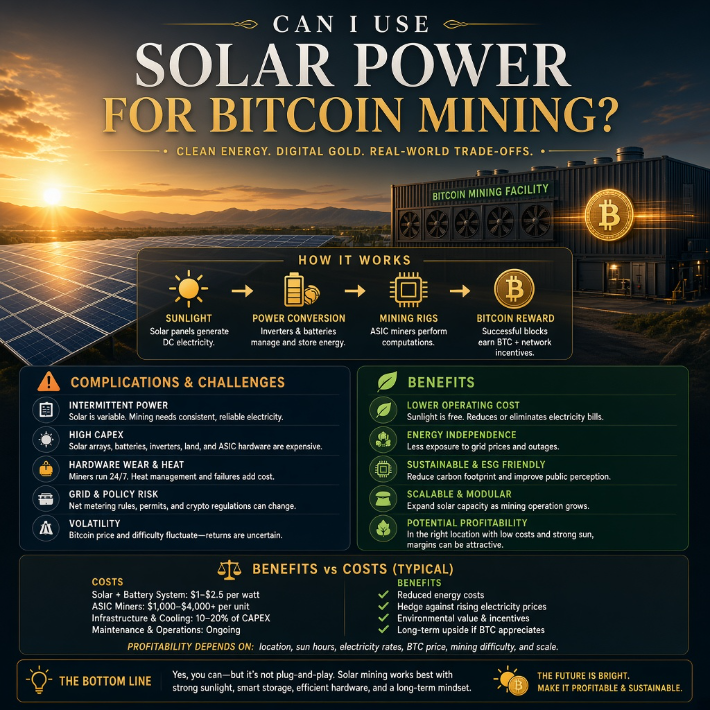 Yes. Solar power can reduce the cost of electricity used for mining. However, you must consider nighttime operation, seasonal production, batteries if needed, grid electricity, equipment costs, and how much of your generated electricity the miner can actually use.
 A new machine may have a warranty and known operating specifications. A used machine may cost less initially but could have worn fans, degraded components, no remaining warranty, or a shorter useful life. Compare efficiency, purchase price, condition, and expected operating costs.
 Solo mining means mining independently rather than sharing block rewards through a mining pool. If your miner successfully finds an accepted block, you receive the associated reward and fees. However, a small miner may wait a very long time for a block.
 Pool mining combines the hashing power of many miners. Participants submit proof-of-work shares that help the pool measure their contributions. When the pool earns a block reward, it distributes payouts according to its payment method, fees, and pool rules.
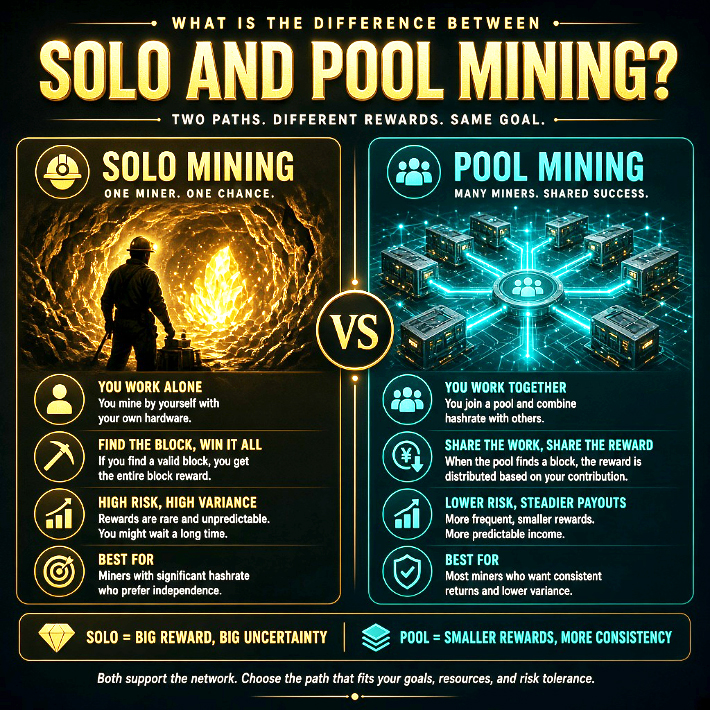 Solo mining:
- Independent block validation directly on the network
- Retains 100% of the block reward and fees
- Zero pool or operator fees
- Extremely high variance and low probability of success
- You compete entirely on your own against the entire global network
- Risk of total loss: The chance of finding a block with individual machines is extremely slim, sometimes akin to searching for a needle in a haystack for years
- Full control: You keep the entire reward yourself, without deductions, should you manage to solve a block
Pool mining:
- You connect your equipment to a shared group (a pool) with others
- Combined computational hash power across multiple users
- Proportional rewards distributed based on hash rate contribution
- Incurs a small operator fee (typically 1% to 3%)
- Regular, predictable, and frequent income streams
- Steady income: You pool your computing power, leading to more frequent block discoveries and the distribution of smaller, consistent daily rewards
- Fees and trust: The pool operator takes a small portion of your earnings as a fee (often 1–3%), and you must trust that payouts are handled correctly
- Lowers the barrier to entry for smaller operators.
Comparison: Solo vs. Pool Mining Feature
| Feature | Solo Mining | Pool Mining |
|---|---|---|
| Payout Frequency | Rare / Unpredictable | Regular / Daily |
| Reward Size | Full block reward (e.g., 3.125 BTC + fees) | Fractional, proportional share |
| Fees | 0% | 1% – 3% |
| Risk / Variance | Extremely high | Low / Smooth |
| Ideal Hardware Scale | Massive industrial hash rates | Small to medium / Home setups |
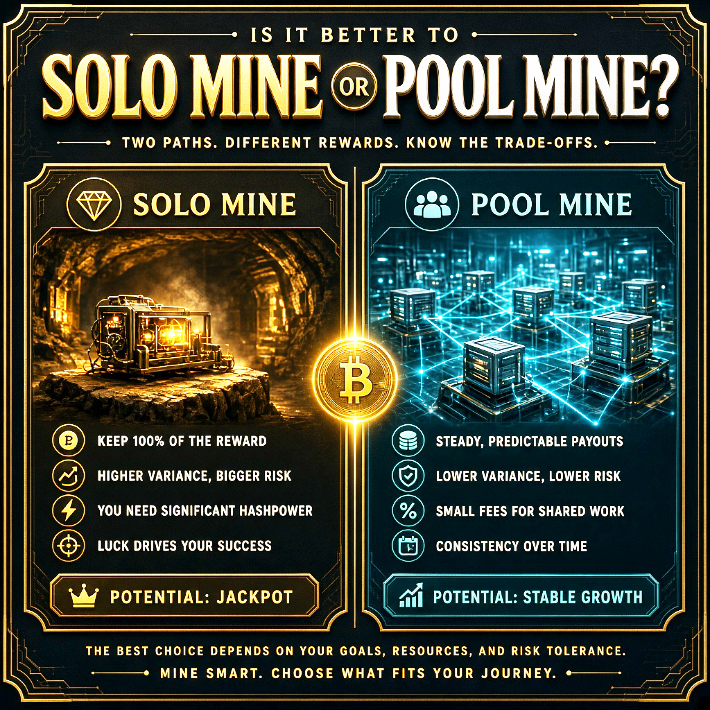 Pool mining is better for most regular miners because it provides steady, predictable daily earnings, while solo mining is like a high-risk lottery with very low odds of success unless you own massive computing power.
 No. Pool mining can make payouts less variable, but it does not guarantee profitability. Electricity, hardware depreciation, fees, network difficulty, Bitcoin’s price, and downtime all affect your result.
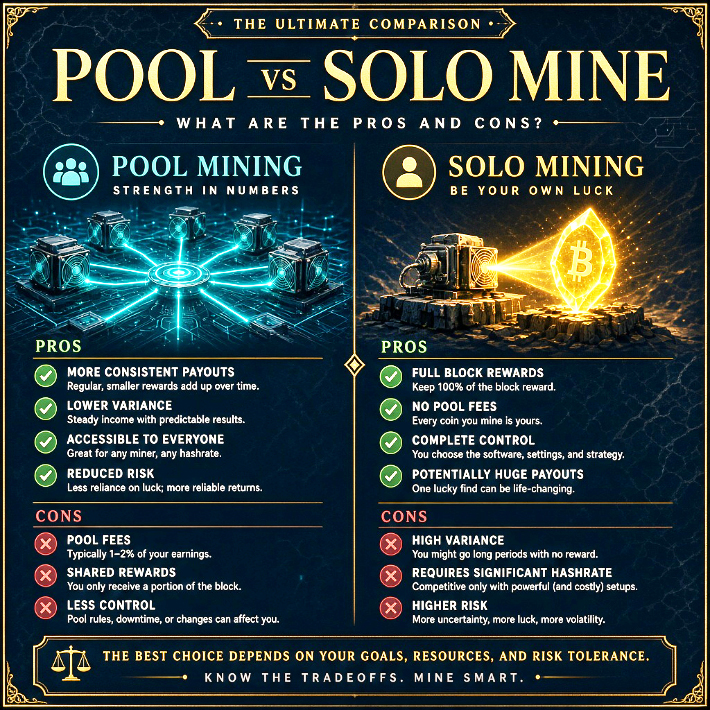 ** Pros **
1. ** Regular Earnings **– When miners pool combine their hashing power with each other, the possibility of situating blocks rises. This partnership generates a much more dependable and regular circulation of mining incentives.
2. No Enormous Up‑Front Costs
The mining pool lets newcomers and beginners start crypto mining without the demand to buy costly ASIC rigs. By merging their computing power with various other individuals and tapping into the cumulative hash price, they can stay clear of the huge initial expense of buying ASIC equipment.
3. Better Security
By sharing their proficiency and resources, miners mining in the swimming pool can better handle rising mining problem and hash rate changes, unlike in solo mining. Hence, they will have much better security and enjoy undisturbed mining.
4. Learning Chance
Pooled mining enables miners, particularly newbies, to communicate with experienced participants and get insights into different mining strategies and methodologies.
5. Community Assistance
The majority of mining pools provide area aid. Expert miners regularly share their knowledge and guide novices, helping them attain reliable mining performance.
** Cons **
1. Mining Pool Charges
To utilize a mining pool’s solutions, miners have to incur a cost. While the expense is generally moderate, it can still impact overall mining profitability.
2. Concentration of Mining Authority
Mining pools are frequently criticized for fostering a focus of mining power. For instance, drivers geared up with high‑performance ASICs dominate the hash‑rate of pool networks, effectively controlling the general system.
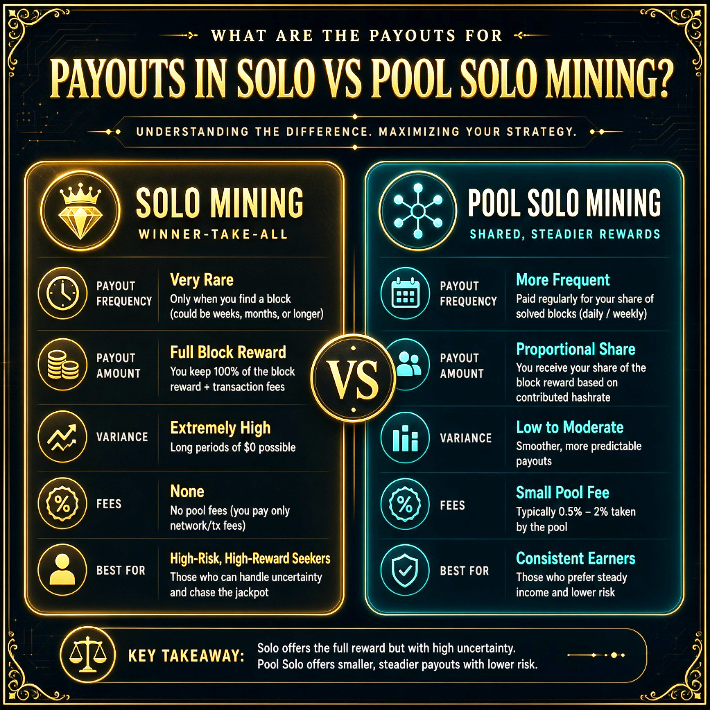 mining uses a single, all-or-nothing payout directly from the network, while pool mining splits rewards into frequent, shared payments using various calculation methods.
 When deciding between solo and pool mining, our standard FAQs cover fees and luck, but several critical factors often get overlooked:
Hidden Financial and Operational Risks:
• Cash flow gaps: Solo mining requires paying constant electricity bills without guaranteed returns.
• Tax complexity: Solo mining creates large, irregular capital inflows that complicate tax reporting.
• Hardware depreciation: Unsuccessful solo runs still wear out expensive ASIC or GPU parts
Technical and Infrastructure Demands.:
• Full node overhead: Solo mining usually demands running and syncing a heavy local blockchain node
• Uptime vulnerability: Pool dropouts or server latency can ruin payout shares in pool setups
• Network configuration: Solo mining requires direct port forwarding and strict firewall management
| Feature | 👤 Solo Mining | 🏊 Pool Mining |
|---|---|---|
| Node Requirement | Must run a full local node | Handled by pool operator infrastructure |
| Tax Impact | Sporadic, large lump-sum windfalls | Frequent, predictable micro-income |
| Failure Cost | Hardware wear + unrecoverable power costs | Lower impact via shared steady yields |
| Setup Security | High exposure to local network attacks | Relies on pool operator security |
5. Money, Costs, and Profitability
6. Mining Other Cryptocurrencies
7. Risks, Security, and Environmental Impact
8. Planning Your First Mining Operation
9. Important Terms to Know
10. Final Questions for Anyone Considering Mining
Electricity cost relative to expected mining revenue. A machine with an impressive hash rate can still lose money if it consumes too much electricity or has high purchase and operating costs.
It is more prudent to estimate profitability first, compare several machines, and check whether your power supply and cooling can support the equipment. A spreadsheet or calculator can help you test different scenarios before committing capital.
 Mining can generate recurring payouts, especially through a pool, but it is not completely passive. Machines need monitoring, cleaning, repairs, cooling, electricity management, and occasional replacement. Revenue can also fluctuate substantially.
When it comes to passive/recurring income, don’t forget to check out our options. You get your own ASIC machine, hosted in a professional Bitcoin mining farm. The income is entirely passive; as long as there is Bitcoin to mine, it will generate returns!
So, there is a much simpler alternative! Take a look at our proposals and what we can offer, (or get in touch with us, and get more & better information!). You won’t have to worry at all about the mining process, equipment selection, or technical details! The service is provided by highly knowledgeable experts, and the hardware comes in various high performance packages.
You pay nothing beyond the hardware itself, no inventory costs, service and maintenance fees, etc.You simply monitor the operation and reap the rewards, because, as mentioned, as long as there is Bitcoin to mine, it will generate income! A look at this FAQ confirms that this is indeed how it works.
If you are interested: Here is what to do: Go to the sign-up page, fill out the form, and we will contact you. Together, we can determine what you want to do and what you’d like to know more about. You will also receive much more detailed information than what is presented here.

Bitcoin mining is both a technical process and a business decision. Understand how proof of work operates, learn the equipment requirements, calculate your costs carefully, and prepare for uncertainty. Never assume that mining will automatically generate a profit.